Macaws are the large, long-tailed parrots of the Neotropics, but they are not all close copies of one another. The group spans six genera, from the 30 cm Red-shouldered Macaw to the metre-long Hyacinth Macaw. Some live in humid forest, others in dry woodland, palm savanna or river-edge habitat. Their conservation stories are just as varied.
San Diego Zoo Wildlife Alliance currently summarizes macaws as six genera and 17 species. The World Parrot Trust presents 16 living macaw profiles and treats the Glaucous Macaw separately among extinct or possibly extinct parrots. That difference is a useful reminder that species lists depend on the taxonomic and conservation source being used.
The six macaw genera
| Genus | Species in this guide | General pattern |
|---|---|---|
| Ara | 8 | Many of the large red, green, blue-and-yellow macaws |
| Anodorhynchus | 3 | The large blue macaws |
| Primolius | 3 | Smaller South American macaws |
| Orthopsittaca | 1 | Red-bellied Macaw |
| Diopsittaca | 1 | Red-shouldered Macaw |
| Cyanopsitta | 1 | Spix’s Macaw |
Compare the 17 macaw species
This quick identification guide compares approximate adult length (including the tail), distinguishing features and native or historical range. Measurements vary among individuals and references; these are rounded guides rather than diagnostic limits. Conservation status changes over time, so consult the linked specialist sources and each species profile for the latest assessment.
| Macaw | Scientific name | Length (cm) | Distinguishing feature | Native / historical range |
|---|---|---|---|---|
| Blue-and-yellow | Ara ararauna | 76–90 | Blue back, yellow chest | Tropical South America |
| Blue-throated | Ara glaucogularis | 80–85 | Blue throat; yellow breast | Bolivian Beni savannas |
| Chestnut-fronted | Ara severus | 45–50 | Chestnut forehead; green body | Northern South America |
| Great Green | Ara ambiguus | 85–90 | Green body; red forehead | Central America and NW South America |
| Military | Ara militaris | 70–75 | Green plumage; red forehead | Mexico and parts of South America |
| Red-and-green | Ara chloropterus | 90–95 | Red body; green wing band | Tropical South America |
| Red-fronted | Ara rubrogenys | 55–60 | Red forehead and shoulders | Bolivian dry valleys |
| Scarlet | Ara macao | 80–90 | Red body; yellow wing band | Central and N South America |
| Hyacinth | Anodorhynchus hyacinthinus | 95–100 | Deep cobalt blue; yellow facial skin | Central South America |
| Lear’s | Anodorhynchus leari | 70–75 | Dark blue; small yellow face patch | Northeastern Brazil |
| Glaucous | Anodorhynchus glaucus | 65–75 | Blue-grey plumage; historical records | Historically southern South America |
| Blue-headed | Primolius couloni | 40–42 | Blue head; green body | Western Amazon basin |
| Blue-winged | Primolius maracana | 40–43 | Green with blue wings; red forehead | Eastern and southern South America |
| Yellow-collared | Primolius auricollis | 38–40 | Yellow band behind neck | Central South America |
| Red-bellied | Orthopsittaca manilatus | 45–50 | Maroon belly patch | Northern South American palm habitats |
| Red-shouldered | Diopsittaca nobilis | 30–35 | Small green macaw; red shoulder | Northern and central South America |
| Spix’s | Cyanopsitta spixii | 55–57 | Blue body; pale grey-blue head | Brazilian Caatinga (historical wild range) |
Ara: the large, familiar macaws
Blue-and-yellow Macaw

Ara ararauna is one of the easiest macaws to recognize: blue above, yellow below, with a green forehead and a white facial patch crossed by narrow black feather lines. It ranges widely across tropical South America and uses forest, woodland, savanna edges and palm-rich habitats. WU has a dedicated Blue-and-Gold Macaw profile.
Blue-throated Macaw
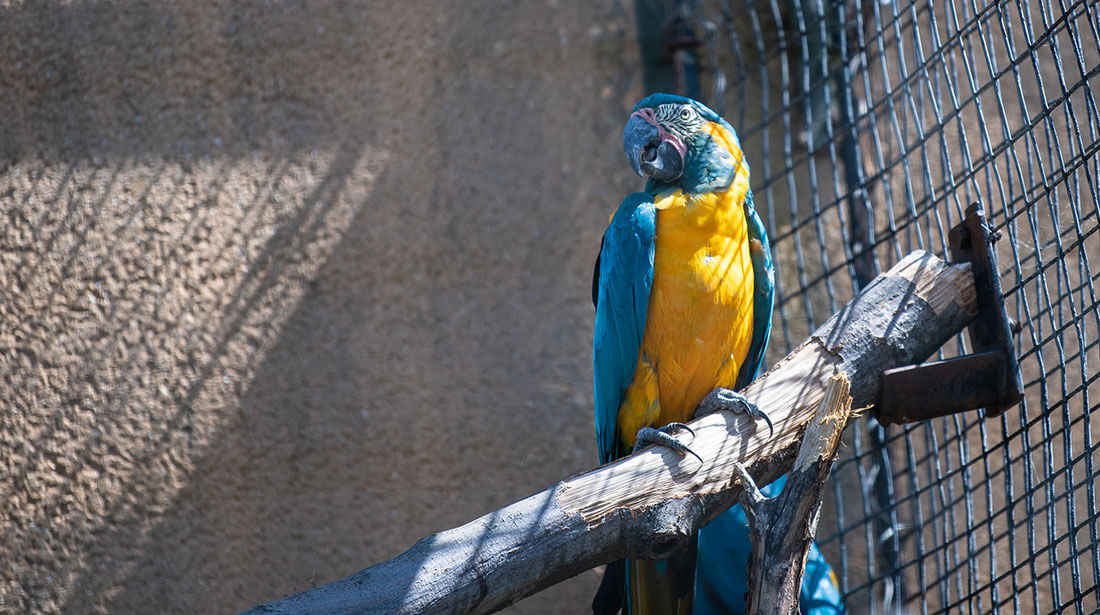
Ara glaucogularis is restricted to Bolivia. It resembles the Blue-and-yellow Macaw at first glance, but the blue throat patch and different facial pattern help separate the two. Its wild range is much smaller, centred on seasonally flooded savannas and palm islands. See Blue-throated Macaw.
Chestnut-fronted Macaw

Ara severus, often called the Severe Macaw, is smaller than the giant Ara species. It is mainly green, with a chestnut forehead, blue in the wings and red under the wing. Its range extends through parts of northern and central South America. See Chestnut-fronted Macaw.
Great Green Macaw

Ara ambiguus is a very large green macaw of Central and northern South America. A reddish forehead, blue lower back and long reddish tail help distinguish it from other predominantly green macaws. It depends heavily on mature forest and large nesting trees.
Military Macaw

Ara militaris is green with a red forehead and blue flight feathers. Populations occur in separated parts of Mexico and South America, often in foothill forest, dry forest and wooded ravines. WU covers it in the Military Macaw guide.
Red-and-green Macaw

Ara chloropterus is sometimes confused with the Scarlet Macaw because both are largely red. The Red-and-green Macaw is generally larger and shows green, rather than yellow, across much of the middle wing. It occurs widely in South America.
Red-fronted Macaw
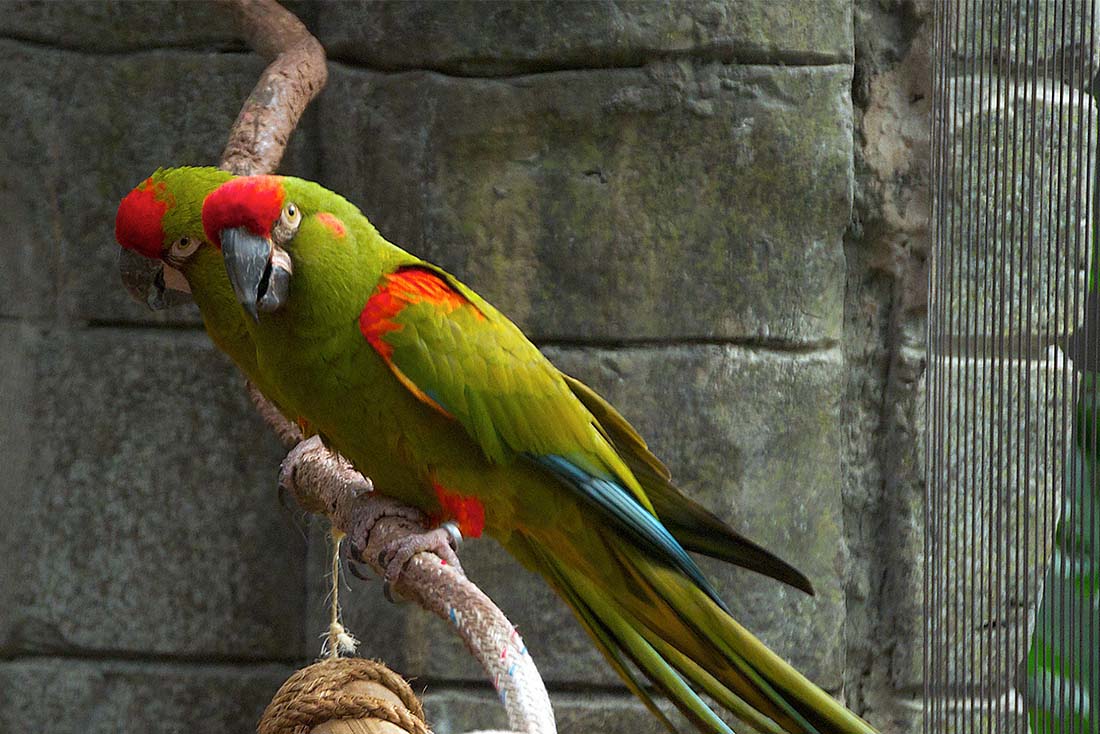
Ara rubrogenys is a Bolivian endemic with a green body, red forehead and red patches around the shoulder and leg. Its restricted dry inter-Andean range makes it very different ecologically from rainforest macaws. WU has a separate Red-fronted Macaw profile.
Scarlet Macaw

Ara macao is one of the classic red macaws, with a scarlet body, yellow wing coverts and blue flight feathers. Its range runs from southern Mexico through Central America into northern South America. See Scarlet Macaw.
Anodorhynchus: the blue macaws
Hyacinth Macaw

Anodorhynchus hyacinthinus is the largest macaw by length. Its plumage is deep cobalt blue, with bright yellow bare skin around the eye and beside the lower mandible. It occurs in central South America, including the Pantanal and other palm-rich landscapes. See WU’s Hyacinth Macaw profile.
Lear’s Macaw

Anodorhynchus leari is smaller than the Hyacinth Macaw and is restricted to northeastern Brazil. It has a dark blue body and a smaller yellow facial patch beside the bill. Cliff nesting and a strong dependence on licuri palms are central to its natural history.
Glaucous Macaw

Anodorhynchus glaucus was a paler blue-grey macaw of southern South America. No verified modern population is known, and specialist conservation sources describe it as possibly extinct. The history, sightings and uncertainty are covered in WU’s Glaucous Macaw profile.
Primolius: the smaller South American macaws
Blue-headed Macaw

Primolius couloni is a compact green macaw with a blue head and blue-grey facial skin. It occurs in the western Amazon basin, particularly around parts of Peru, Brazil and Bolivia, and is often encountered in pairs or small family groups rather than large flocks.
Blue-winged Macaw

Primolius maracana, also called Illiger’s Macaw, is predominantly green with a red forehead and belly patch, blue in the crown and wings, and a blue tail. It is associated with woodland and forest-edge habitats in eastern and southern South America.
Yellow-collared Macaw

Primolius auricollis is named for the yellow band around the back of the neck. The rest of the body is mostly green, with blue in the wings and tail. It occurs across parts of central South America in woodland, savanna and agricultural mosaics.
The single-species genera
Red-bellied Macaw

Orthopsittaca manilatus is closely tied to palm-rich habitats. It is mostly green with a dark maroon belly patch and blue in the wings. Its distribution follows lowland areas of northern South America where suitable palms are abundant.
Red-shouldered Macaw

Diopsittaca nobilis is the smallest macaw, about 30 cm long. It is mainly green with blue on the forehead and red at the shoulder. Hahn’s Macaw is a subspecies of the Red-shouldered Macaw, not an additional full species. See Red-shouldered Macaw.
Spix’s Macaw

Cyanopsitta spixii is a smaller blue macaw with a greyish head. The last known wild bird disappeared in 2000, although conservation breeding kept the species alive and reintroduction work is underway in Brazil. See Spix’s Macaw.
Macaw types commonly kept as pets
People comparing macaw types often want to know more than feather colour. Size, expected lifespan, vocal volume and the amount of daily care can make a far greater difference at home. Macaws are intelligent, social, long-lived birds; none is a quiet, low-maintenance pet. Even the smaller species need space, regular interaction, enrichment and access to an avian veterinarian.
Large and mini-macaws at a glance
| Type often encountered in aviculture | Approximate length, including tail | Noise and talking | Long-term commitment |
|---|---|---|---|
| Blue-and-yellow Macaw | About 76–90 cm | Loud calls; may imitate human words | Large macaw: commonly several decades |
| Scarlet Macaw | About 80–90 cm | Very loud; speech ability varies individually | Large macaw: commonly several decades |
| Red-and-green Macaw | About 90–95 cm | Powerful calls; may learn words | Large macaw: commonly several decades |
| Chestnut-fronted (Severe) Macaw | About 45–50 cm | Smaller body, but still capable of loud calls and mimicry | Mini-macaws may live for decades |
| Yellow-collared Macaw | About 38–40 cm | Vocal and social; talking is not guaranteed | Mini-macaws may live for decades |
| Red-shouldered (including Hahn’s) Macaw | About 30–35 cm | Can be noisy despite its size; some individuals imitate speech | Mini-macaws may live for decades |
About lifespan: Veterinary guidance gives broad averages of roughly 30–40 years for mini-macaws and 50–60 years for larger macaws, with individual variation and some birds living longer. These are care-planning estimates, not guaranteed lifespans for each species. Likewise, no species can be promised to be a good talker or suitable for an apartment. See Macaws as pets for ownership considerations and How macaws learn to talk for behaviour.
What about Catalina, Harlequin and Camelot macaws?
These popular names refer to hybrids produced by crosses between macaw species, rather than three additional wild species. A Catalina Macaw is usually a Scarlet × Blue-and-yellow cross; a Harlequin is a Red-and-green × Blue-and-yellow cross; and a Camelot is commonly a Scarlet × Catalina cross. Appearance and temperament can differ widely between individual hybrids, and breeder names do not form a scientific species list.
Before considering any companion macaw, prioritise documented legal captive-bred origin, welfare and long-term care rather than unusual colour combinations. The World Parrot Trust’s position on keeping and breeding parrots emphasises proper care and reducing demand for wild-caught birds.
Care references: VCA Animal Hospitals: Macaws — General (veterinary guidance on lifespan, size, noise and talking) and PetMD: Macaw birds, types and care. Hybrid names describe common avicultural crosses, not a formal taxonomic standard.
Which macaw is the largest and which is the smallest?
The Hyacinth Macaw is the largest macaw by length, reaching about 100 cm. The Red-shouldered Macaw is the smallest, at roughly 30 cm. That range is one reason a simple image search for “macaw” can be misleading: the group includes birds that differ dramatically in body size, colour and ecology.
Why “blue macaw” is not one species
Hyacinth, Lear’s, Glaucous, Spix’s and Blue-throated Macaws can all enter a conversation about “blue macaws”, but they are not interchangeable. Some belong to different genera, live in different habitats and have very different conservation histories. If the question is whether blue macaws are extinct, see Are Blue Macaws Extinct?.
Species, subspecies and hybrids are different things
A species list should not become longer simply because a subspecies or a captive-bred hybrid has been counted as another wild species. Hahn’s Macaw, for example, sits below the Red-shouldered Macaw at subspecies rank. Hybrid names used in aviculture describe crosses between species; they are not extra wild macaw species.
Frequently asked questions about macaws
How many species of macaws are there?
San Diego Zoo Wildlife Alliance recognises 17 species across six genera. Counts can differ between references because some include possibly extinct species or use different taxonomic treatments. Hahn’s Macaw is a subspecies of the Red-shouldered Macaw, not an eighteenth full species.
What is the largest macaw?
The Hyacinth Macaw (Anodorhynchus hyacinthinus) is the largest macaw by body length, reaching roughly one metre including its long tail. Its deep-blue plumage and bright yellow facial skin distinguish it from other blue macaws. Read the Hyacinth Macaw guide.
What is the smallest macaw?
The Red-shouldered Macaw (Diopsittaca nobilis) is the smallest, at roughly 30–35 cm long. The familiar Hahn’s Macaw belongs to this species as a subspecies. See our Red-shouldered Macaw profile.
How can you tell a Scarlet Macaw from a Red-and-green Macaw?
Both have predominantly red plumage, but a Scarlet Macaw usually has a conspicuous yellow band on the wings, while a Red-and-green Macaw has green middle-wing coverts. The latter is generally larger. Use more than colour alone when identifying a bird from a photograph.
Are all blue macaws the same species?
No. Blue-and-yellow, Blue-throated, Hyacinth, Lear’s and Spix’s Macaws are distinct species, and some belong to different genera. Their size, facial markings, plumage and geographic ranges differ. See Are Blue Macaws Extinct? for the conservation distinction.
Are Spix’s Macaws extinct?
Spix’s Macaw is classified as Extinct in the Wild, not globally extinct. Birds survived in managed breeding populations, and reintroduction projects released birds in Brazil in 2022 and 2025. These releases do not, by themselves, establish a self-sustaining wild population. Read the Spix’s Macaw profile.
Is the Glaucous Macaw extinct?
The Glaucous Macaw is considered Critically Endangered (Possibly Extinct) by the World Parrot Trust. It has not been reliably recorded since the twentieth century, and searches of its former range have not confirmed surviving birds. Historic illustrations and photographs should not be mistaken for proof of a living population. See the Glaucous Macaw guide.
Where do macaws live in the wild?
Macaws are native to parts of Mexico, Central America and South America. Their habitats include tropical forest, palm-rich wetlands, savanna, dry woodland and, for the Red-fronted Macaw, Bolivia’s dry inter-Andean valleys. Not every species lives in the Amazon rainforest.
Are all macaws endangered?
No. Conservation risk differs greatly by species and population. Some widespread species are assessed as Least Concern, while the Blue-throated Macaw is Critically Endangered and Spix’s Macaw is classified as Extinct in the Wild. Habitat loss and capture for trade are major threats to several species. Check the species-specific assessment rather than treating all macaws alike.
Further reading: San Diego Zoo Wildlife Alliance: Macaw; World Parrot Trust: Spix’s Macaw; World Parrot Trust: Glaucous Macaw search; World Parrot Trust: Blue-throated Macaw conservation.
Sources
This guide follows current specialist and zoological references, especially the World Parrot Trust macaw directory and the San Diego Zoo Wildlife Alliance macaw overview. Taxonomy can change as new evidence is adopted, so species totals and names should always be read with the source and date in mind.

The photo for the Red-fronted macaw is a photo of a different macaw, NOT a red- fronted macaw.
Hi Roberta, Thanks for the correction