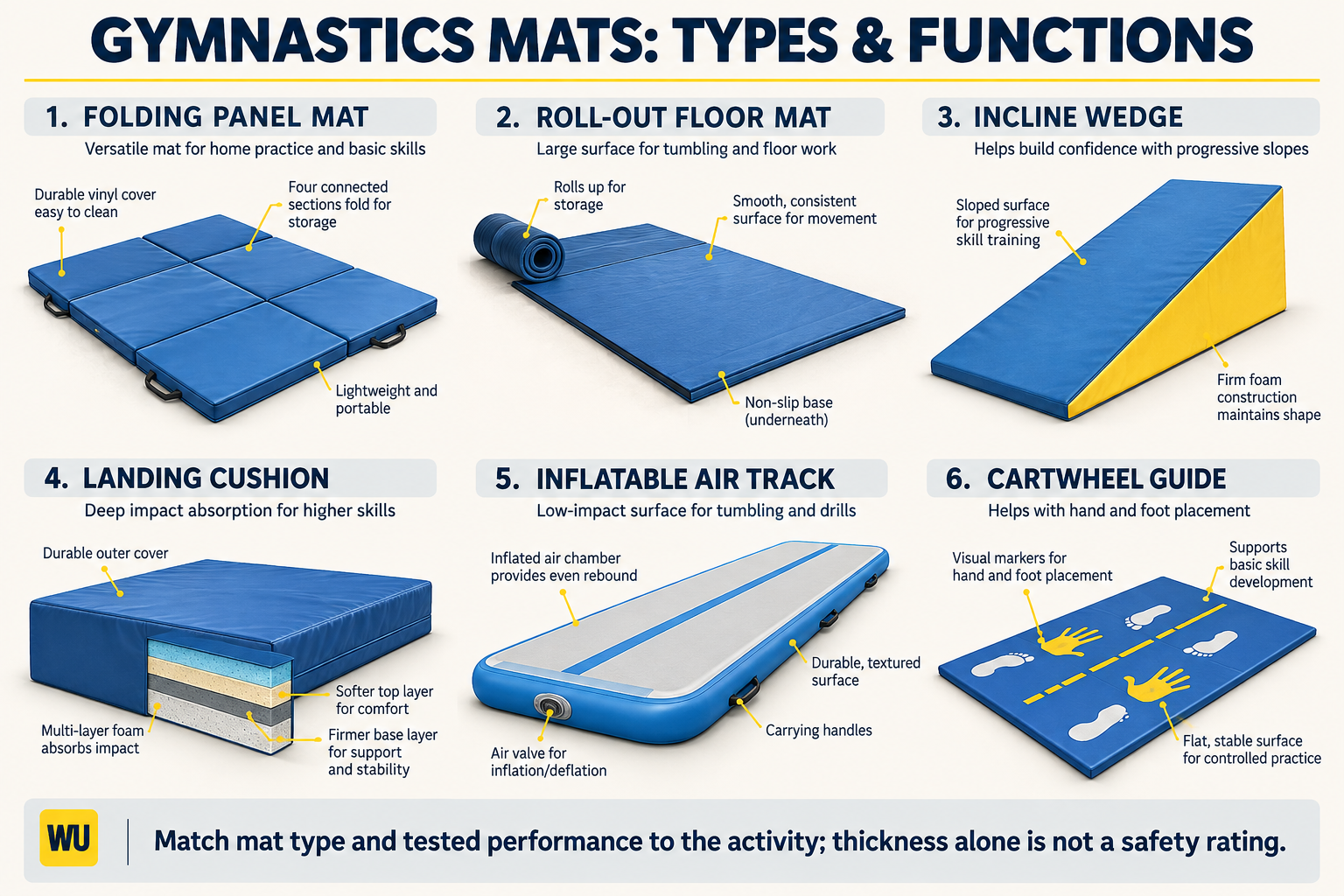
The right gymnastics mat depends on the skill, landing conditions and coaching—not just the thickness printed on the label. Folding panel mats, incline wedges, inflatable air tracks and deep landing mats perform different jobs. For basic coached floor drills at home, an appropriate stable panel mat may be useful; for tumbling, apparatus dismounts or other high-impact skills, a coach should specify the correct surface and controlled training environment.
A thick, soft mat can still slip, bottom out or make balance difficult. No household mat removes the risks of unsupervised flips or falls from equipment. This guide compares mat construction, protective properties, dimensions and maintenance without product rankings.
Gymnastics mat types: which one is for what?
| Mat type | Typical purpose | Important limitation |
|---|---|---|
| Folding or panel mat | Selected rolls, floor drills, flexibility and supervised basic technique | Not automatically suitable for high-energy landings |
| Roll-out or carpet-bonded foam | Large practice areas, drills and transitions | Construction and cushioning vary widely |
| Incline wedge or cheese mat | Coach-guided learning progressions and position changes | Sloping surface is not a general crash mat |
| Landing or skill cushion | Specific coached landings or training aids | Must match expected impact and apparatus setup |
| Inflatable air track | Rebounding tumbling work under suitable supervision | Pressure, edges and rebound alter movement |
| Cartwheel marking mat | Hand/foot placement guidance | Markings do not indicate impact-test performance |
| Competition floor or apparatus matting | Purpose-built gym installation | Cannot be recreated simply with household mat layers |
Why mat thickness alone does not determine safety
Thickness is only one dimension. Foam stiffness and compression, its ability to dissipate energy, layering, rebound and how the mat interacts with the floor all affect a landing. A soft surface might feel comfortable during a kneel but compress sharply when a gymnast lands. An excessively yielding surface can also alter balance or skill execution.
The European standard EN 12503-1:2013, listed as current by national standards bodies, describes safety and performance requirements for eight classes of gymnastics mats used in education, training and competition. Its scope includes shock absorption, underside slip resistance and upper-surface friction. A mat being called “gymnastics grade” does not establish that it complies with this standard.
How much thickness do gymnastics mats need?
Common retail mat listings use figures such as 1–2 inches for some folding panels and much thicker constructions for specialist landing cushions. Those are product dimensions, not recommended universal safety thresholds. Thickness cannot be prescribed from a child’s age or a skill name without considering mat construction, the apparatus and a coach’s assessment.
For an apparatus dismount or advanced acrobatic landing, rely on the relevant governing-body requirements and professional facility setup. Competition dimensions should never be reinterpreted as a simplified home-purchase recommendation.
What landing research actually shows
In a 2025 peer-reviewed study, researchers including Pavel Brtva, Gareth Irwin and Roman Farana compared landing biomechanics across a FIG-certified gymnastics mat, gymnastics carpet and three experimental mat structures. Eleven trained female gymnasts and eleven untrained participants completed controlled drop-landing tasks. Mat construction affected measured forces and joint movement, while gymnasts and non-gymnasts responded differently. The FIG-certified mat produced the lowest peak forces among the compared surfaces in this study. These laboratory outcomes do not guarantee that a particular household mat prevents injuries.
Earlier biomechanical research also cautioned against focusing on just one material property. A landing-mat simulation study examined how stiffness, damping and friction alter ankle loading, while a separate modelling study found that changes which reduced some peak landing forces could increase forefoot forces. These are experimental or model-based findings, not proof of a universally best softness.
What gymnastics authorities recommend
British Gymnastics includes roll matting, safety mats and incline equipment among its suggested resources for supervised recreational gymnastics, with the required equipment depending on space and activity. Its recreational equipment guidance demonstrates that different mat types fill different roles; it does not endorse a one-mat setup for every skill.
Its health-and-safety guidance recommends visual pre-use equipment checks and documented weekly inspections at gymnastics facilities. That is club-operation guidance, but the practical principle applies at home: never overlook torn covers, damaged foam, loose joining edges or slippery undersides.
World Gymnastics, the international federation, maintains separate apparatus norms and an approved apparatus listing with different categories of landing mats. These are specialised competition requirements—not a blanket certification of consumer folding mats.
Foam density, firmness and layered construction
Foam types vary in how quickly they compress, rebound and recover. Labels such as high density, cross-linked polyethylene or polyurethane describe material families or properties, but without relevant test results they cannot tell a parent what fall the finished mat can safely accommodate.
Construction matters as much as the named foam: multi-layer assemblies may combine a firmer stabilising layer and a more yielding impact layer. Cover tension, seams and trapped air can also influence performance. Do not assume that two cheap mats stacked together will reproduce a tested professional landing mat: layers can shift or leave a concealed gap.
Mat dimensions, joints and room layout
- Measure usable floor length and width, plus the space a gymnast may travel beyond the intended drill.
- Consider mat coverage around apparatus and how a missed step could land outside the protected zone.
- Avoid seams, connector gaps and raised borders in the likely hand- or foot-placement path.
- Position mats on the floor type specified by their manufacturer, away from sharp furniture and hard obstacles.
- Check overhead clearance and whether apparatus movement could change the eventual landing position.
- Do not assume joining two folding mats creates a continuous impact-rated landing zone.
A short, narrow mat may be suitable for stationary stretching yet unsuitable for a travelling floor drill. Evaluate the actual movement envelope, not just the footprint of the starting position.
Folding mats, air tracks and landing cushions compared
| Question | Folding foam panel | Inflatable air track | Deep landing cushion |
|---|---|---|---|
| Does it rebound? | Usually limited; depends on construction | Often substantial and pressure-dependent | Designed for specific cushioning behaviour |
| Is it easily stored? | Panels fold; storage space required | Can deflate and roll; pump required | Often heavy and bulky |
| Does it suit basic home drills? | May, for approved low-impact activities | Only with appropriate skill and supervision | Often unnecessary for basic drills |
| Does thickness prove landing suitability? | No | No | No |
| Main inspection point | Foam, seams, joins, underside | Air pressure, punctures, seams and edges | Compression recovery, cover, seams and positioning |
Air tracks: bounce is not the same as protection
An air track changes firmness when inflation pressure changes. It can also produce rebound that alters technique and the distance travelled. Correct pressure depends on the product and approved use; harder inflation is not automatically better. Check for leaks, seam problems and the transition from raised track to surrounding floor.
A child who can perform a movement on a sprung surface may not be able to perform it safely on a firm floor. Training should not encourage unsupervised transfer of more difficult skills between surfaces.
Gymnastics mats for children: home practice boundaries
Match the exercise to the child’s existing coached skill level—not an age bracket on a product page. Stretching, conditioning and carefully selected floor drills are different from back handsprings, aerial skills or dismounts from bars. Parents should ask the gymnast’s coach which drills can safely be repeated at home and which belong at a supervised facility.
When a mat is used with a home gymnastics bar, its position and specification should follow the apparatus instructions and coach assessment. See our home gymnastics bars guide for the separate issues of frame stability, bar height and clearance. A soft mat cannot make an unstable bar safe.
Before use: a mat safety checklist
- Identify the exact exercise and confirm it is suitable for home practice.
- Confirm mat type and impact characteristics are appropriate for the skill.
- Place the mat flat and ensure it does not slide or rock.
- Inspect the cover, foam, fold seams, hook-and-loop joins and handles.
- Check that the expected landing and movement area is clear of edges or obstacles.
- Follow the manufacturer’s instructions for air-track pressure and inflation if applicable.
- Use appropriate adult supervision and qualified coaching for the skill.
- Stop if the mat shifts, bottoms out, leaks or shows damage.
Cleaning, storage and replacement
Wipe mats according to the cover manufacturer’s care instructions and allow them to dry fully before folding or stacking. Abrasive chemicals, heat and trapped moisture may damage materials. Inspect frequently for torn covers exposing foam, crushed sections that do not recover, weakened seams, slippery backing and defective fastenings.
There is no universal replacement interval. A mat that has deteriorated or suffered an unusual heavy impact should be assessed and removed from use if it cannot meet its intended function. Follow the manufacturer’s inspection schedule and any gymnastics club safety policy.
Common mistakes when choosing gymnastics mats
- Shopping by colour, price or thickness instead of intended exercise.
- Confusing a yoga mat, cartwheel guide or incline wedge with an impact landing mat.
- Using competition dimensions as a universal recommendation for home children’s gymnastics.
- Believing a thicker mat makes unsupervised flips or bar dismounts safe.
- Ignoring gaps between panels or placing a mat where a fall could miss it.
- Assuming every air track has the same rebound, firmness and use limits.
- Treating published biomechanical studies as proof that an untested consumer mat prevents injury.
Frequently asked questions
Is a 2-inch gymnastics mat enough?
Not for every gymnastics activity. A two-inch label describes thickness, not verified landing performance. Use the manufacturer’s specified use and qualified coaching advice.
Are crash mats better than folding mats?
They do different jobs. A crash or landing cushion may be built for certain impacts, while a folding panel can suit selected floor drills. Neither is interchangeable across all exercises.
Can you put gymnastics mats over carpet?
Only where the manufacturer permits that floor surface and the complete setup stays stable. Thick pile can affect mat movement or footing.
Are air tracks safer for tumbling?
Not automatically. Pressure and rebound change the movement, and safe practice depends on training, supervision and correctly specified equipment.
Are home gymnastics mats suitable under bars?
Only if the bar instructions and a qualified coach specify that type and placement. Basic exercise mats cannot be assumed to provide safe dismount protection.
Related WU gymnastics guidance
Continue with home gymnastics bars: types, safety and setup. Matching the apparatus, matting and intended skill is more important than treating any one item as a standalone safety solution.
