A gymnastics bar at home can support supervised introductory exercises for children, but it cannot replace club equipment or a coach. The right setup depends on the child’s height, training experience, suitable matting and the manufacturer’s permitted movements.
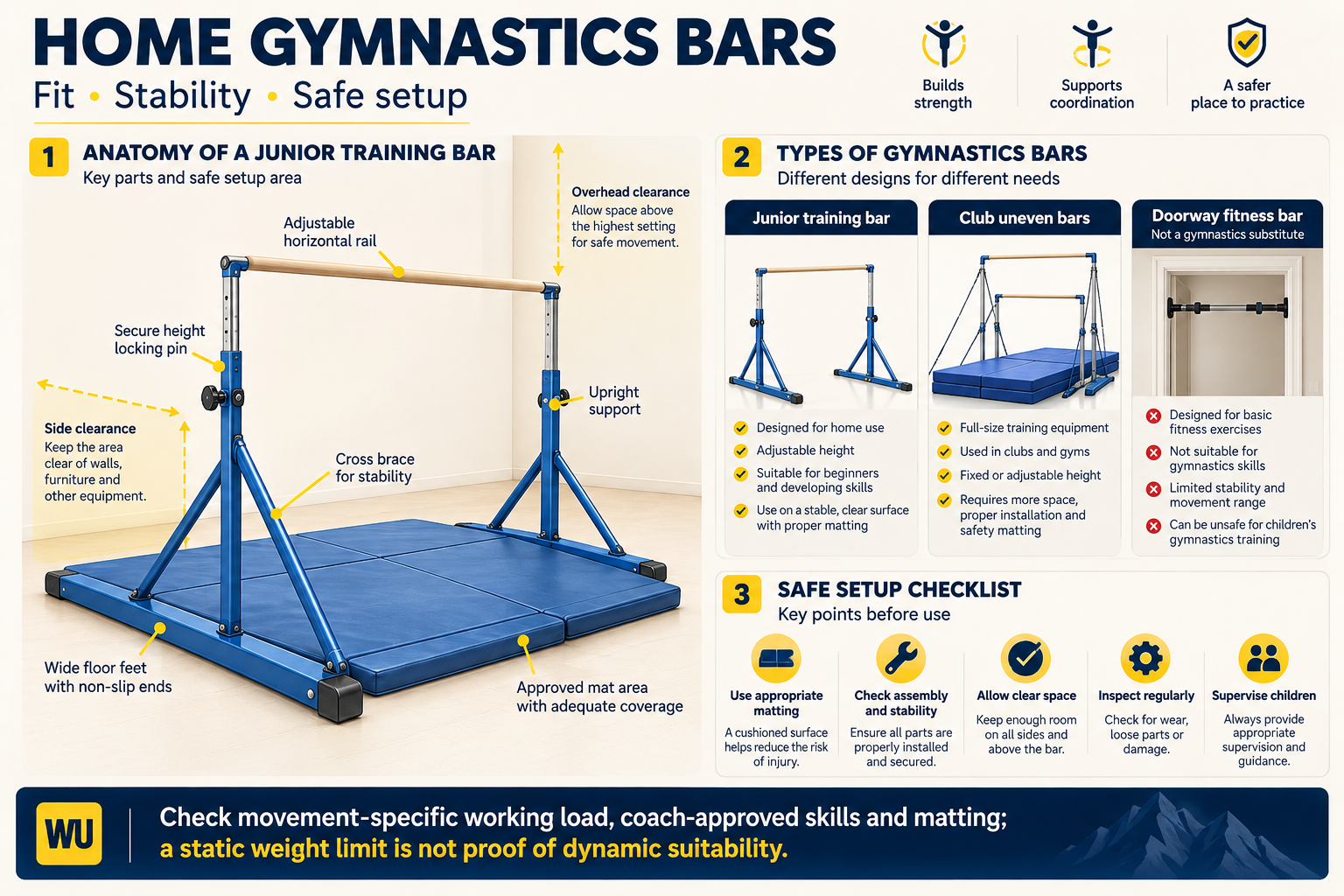
Types of home gymnastics bars
Freestanding adjustable kip bars have a single horizontal bar and a supporting frame. Height adjustments can accommodate different children or exercises, but the frame’s intended uses and permitted dynamic movements vary between manufacturers.
Fixed installations and more advanced equipment require appropriate structural mounting, protective surfaces and supervision. A doorway pull-up bar or a playground frame is not a substitute for a purpose-built gymnastics training bar.
Match the equipment to the child
Age labels are approximate. A child’s reach, coordination, training level and intended exercises matter more than a marketing age range. Select a setting that allows the coach-approved activity without compromising safe clearance.
Read the exact model’s guidance for height adjustments and load limits. A static weight rating does not establish that the equipment can safely handle swings, kips or releases.
Floor space, ceiling clearance and mats
Measure the assembled footprint and clear all sides of walls, furniture, windows and doorways. Consider how the child’s body moves around the crossbar, not just the space occupied by the support legs.
Mats need to suit the activity and potential landing forces. A bundled foam mat or household carpet is not necessarily suitable for falls. Read our guide to gymnastics mats and bar installation advice.
Safe use and supervision
Ask a qualified coach which basic grip, positioning or conditioning exercises are appropriate for the specific home bar. Advanced dismounts and powerful dynamic skills may require professional gym facilities. Adults should supervise every session and inspect the equipment first.
Follow the manufacturer’s assembly instructions, tighten fittings as specified and check for movement, frame damage or worn components. Stop if the bar shifts unexpectedly. Do not improvise structural modifications.
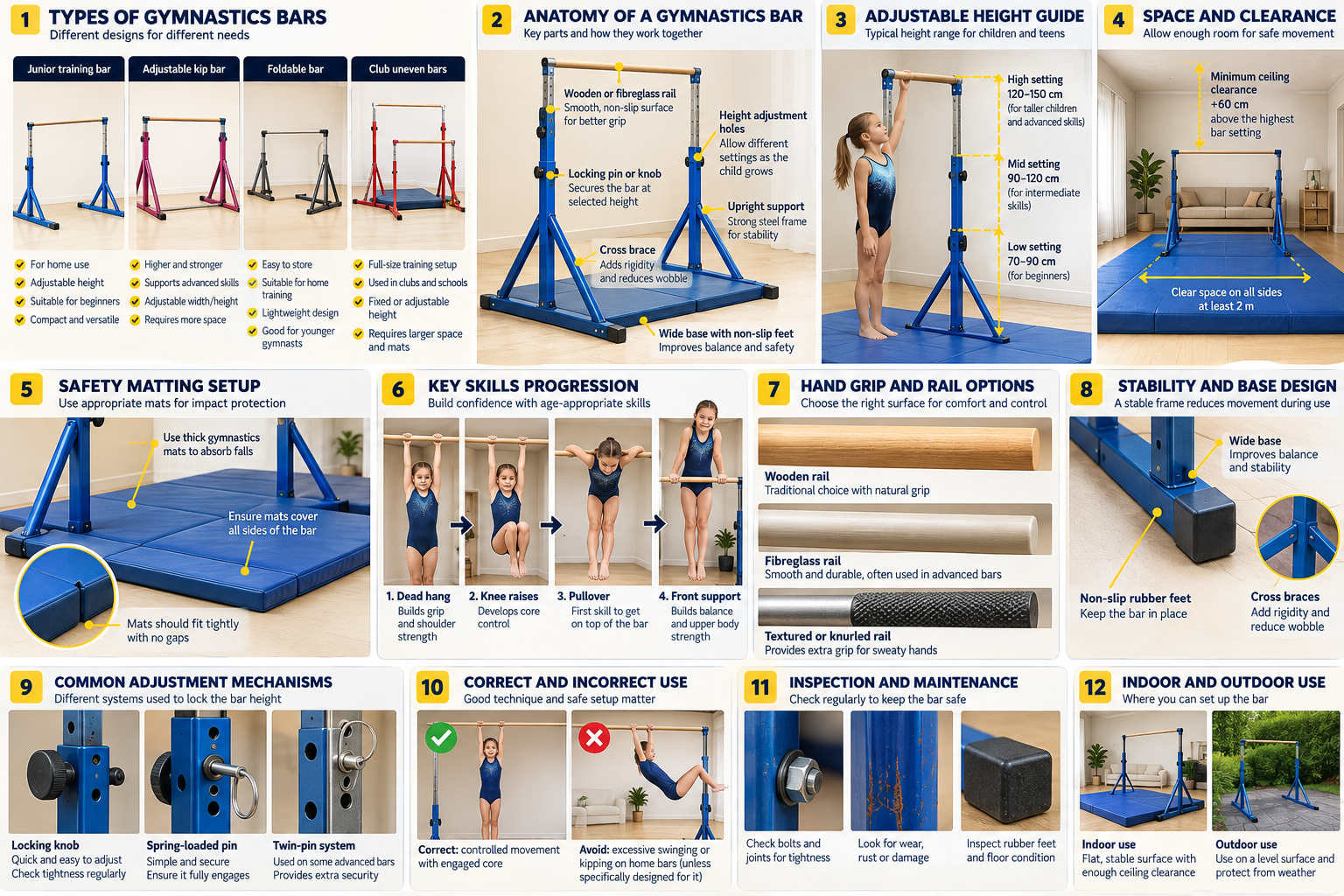
Important: Do not use the illustration’s example measurements as installation requirements or use its skill progression as permission to attempt a movement. Suitability depends on the exact bar model, the gymnast’s abilities, protective matting and coaching.
What to check before choosing a bar
Check the gymnast’s coached skills, the model’s movement-specific working-load limit, height-adjustment locks, rail material, supporting frame and clearance. A product marketed as a kip bar does not automatically permit powerful kips, casts or hip circles. A static hanging weight rating is not equivalent to approval for swinging loads.
Measure the bar’s assembled footprint and the space through which the child may move. Ensure floor conditions, matting and any required anchoring match the exact manual. Avoid using doorway pull-up bars or playground frames as substitute gymnastics apparatus.
Different bar constructions and mat layouts
Freestanding junior bars, foldable single-rail training frames and club uneven bars have different support systems and intended uses. An elevated centre crossbrace may prevent a mat from lying flat, requiring a specific protective layout. The appropriate protective mat depends on the particular bar and movement, not just its thickness.
For impact performance, mat styles and seams, consult our gymnastics mats guide. A mat cannot make an unstable bar safe.
Gymnastics equipment standards
The current EN 913:2018+A1:2021 standard describes general safety requirements and tests for supervised gymnastics equipment, where more specific rules do not apply. Advertising a standards number does not establish independent certification of a home product.
World Gymnastics uneven-bars testing procedures cover dynamic characteristics and stiffness of sanctioned apparatus and caution that even compliant equipment cannot eliminate injuries. A home training rail should not be assumed to meet competition requirements.
What experienced gymnastics specialists advise
Paul Hall of British Gymnastics, working with Michael J. Hiley, Maurice R. Yeadon and Gareth Irwin, investigated how technique choices in parallel-bar gymnastics relate to physical preparation. Their 2025 research shows why a coach should assess the specific movement and athlete, rather than choosing a bar based on a list of tricks. The study is not a test or endorsement of home bars.
A review of gymnastics biomechanics similarly calls for integrating biomechanics, motor learning and coaching. These researchers were not interviewed by WU, and their findings do not establish that any particular home bar is safe.
Equipment inspection and storage
Before every session check the rail for cracks or rotation, frame for looseness or corrosion, height-lock pins for proper engagement, feet for stable contact and mats for shifting or gaps. Stop immediately if a joint loosens or the frame moves unexpectedly.
British Gymnastics advises daily visual checks and recorded weekly inspections for clubs. At home, follow the maker’s inspection and servicing schedule; never substitute improvised clamps, screws or tapes for structural repairs.
Common mistakes to avoid
Do not choose by the child’s age alone, rely on a static load number for dynamic gymnastics, use unrelated protective matting or install a frame without required fixings. Never allow unsupervised flips or bar dismounts simply because a product is labelled suitable for home use.
A child’s coach should identify which limited drills can be safely practised at home and which must remain in a suitably equipped gymnastics facility.
Home gymnastics bars compared
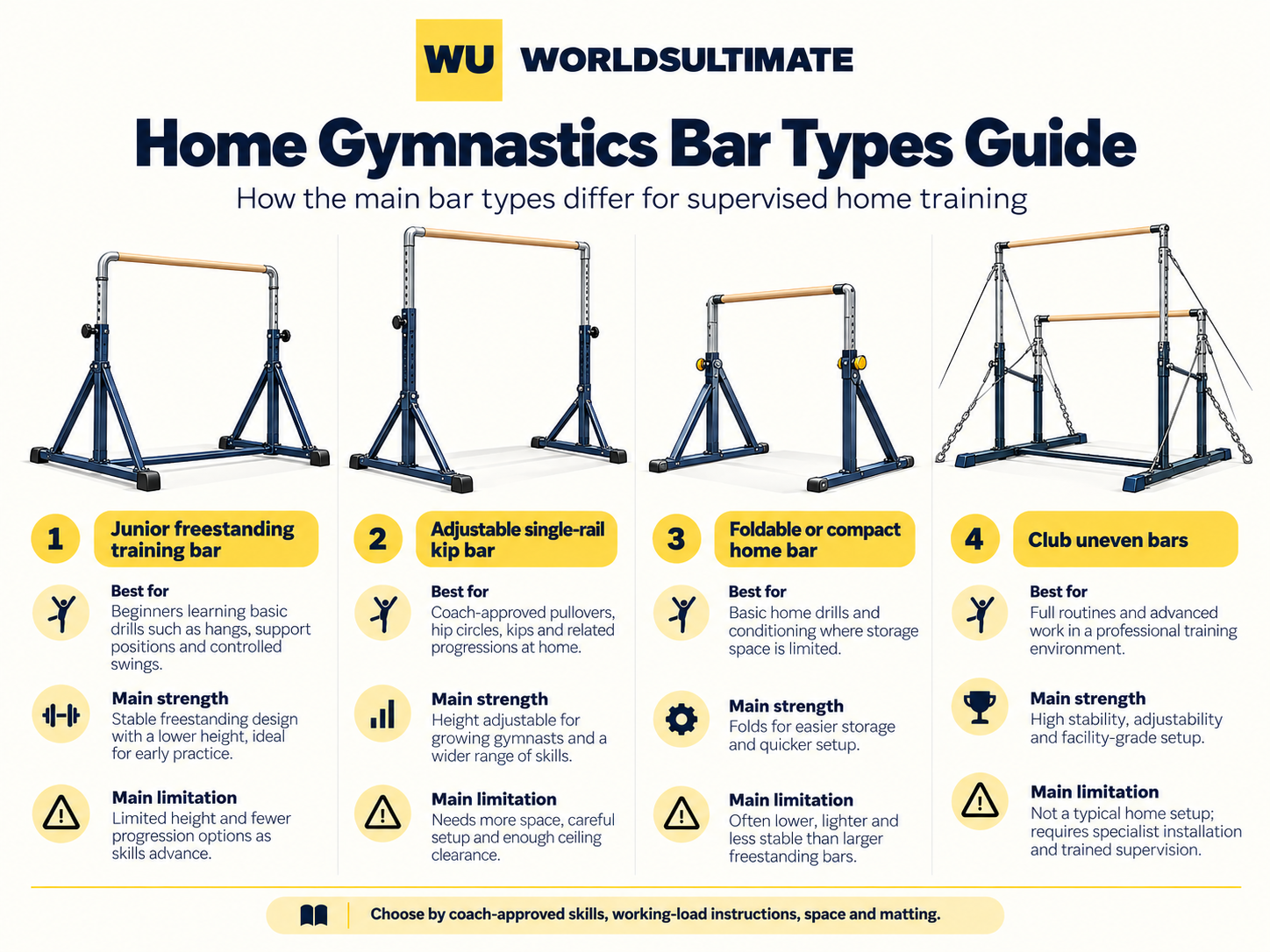
| Bar type | Main purpose | Key limitation |
|---|---|---|
| Junior adjustable rail | Coach-approved home drills | Dynamic loads and locks vary |
| Foldable home bar | Storage flexibility | Assembly and bracing must be checked |
| Club uneven bars | Advanced coached apparatus skills | Not a home-equipment substitute |
| Doorway pull-up bar | Fitness pull-ups | Not rated as a gymnastics rail |
Skill suitability comes before age
A beginner may need only coach-approved hanging positions and basic conditioning. Pullovers, casts, hip circles and kips have different demands: the child’s existing skills and the exact frame’s movement-specific approval matter more than an age range. A bar’s name does not certify the exercises it can support.
Room measurement and clearance
Measure ceiling height, full frame footprint, bar height and space ahead of and behind the apparatus. Account for unintended movement, not just a perfect drill. Keep the potential movement zone free from fans, windows, furniture, fixtures and hard edges.
Choosing matting for the exact frame
Different frames have low or raised floor crossbars. A raised brace can prevent a protective mat from lying flat; the approved mat layout therefore depends on both equipment and activity. Do not assume a bundled mat or household foam is suitable for falling or dismounting.
First-session setup checklist
Assemble every brace and fastener as specified, engage height-adjustment locks, inspect rail and support feet, confirm required floor and mat placement, and supervise the child continuously. Stop if unexpected rocking, noise or rotation develops. Never use improvised structural fixes.
When to retire or repair equipment
Follow the maker’s inspection and servicing instructions. Cracked rails, damaged welds, distorted uprights, defective locking pins or an unstable base require stopping use. Only approved components and competent repairs should restore a load-bearing frame.
Static ratings, working loads and the missing safety question
A model may list a maximum weight without saying whether the measurement covers a stationary hang, repeated swings or other moving skills. Those demands are not interchangeable. Ask the seller for the exact permitted exercises, working-load definition, assembly requirements and supporting documentation. Avoid applying a guessed bodyweight multiplier: it cannot replace equipment-specific dynamic testing.
One manufacturer’s junior-bar selection guide, for example, reports a distinct dynamic working-load limit while explaining that its alternative supporting frames call for different mat configurations. The important general lesson is to compare actual permitted use and the complete setup rather than advertising claims. WU does not recommend or link to a commercial model.
A practical bar-selection decision table
| Question | Look for | Warning sign |
|---|---|---|
| What movement? | Manufacturer-approved, coach-selected drill | Skill only shown in promotional photos |
| What load? | Movement-specific limit and instructions | Static capacity presented as universal |
| What frame? | Locked height settings, secure braces and stable feet | Rocking, missing fasteners or unapproved modification |
| What room? | Full body movement envelope and overhead clearance | Floor footprint fits but swing path does not |
| What matting? | Approved placement for the exact frame and skill | Loose matting, uncovered gaps or raised braces |
| What future use? | Documented suitability as skills change | Assuming a higher bar setting permits advanced skills |
Understanding basic bar-skill names
Parents see different skill names in equipment adverts, and those labels can conceal large differences in loading. A pullover brings the gymnast from below the bar into a support position above it; a cast moves the body away from front support; a hip circle involves rotation around the rail; and a kip uses coordinated swing and body movement to reach support. None should be assumed suitable for unsupervised home learning. A coach must decide what to practise and where.
Even short drills depend on a child’s readiness, technique and fatigue. A more difficult movement should not be introduced simply because a bar’s height can be increased. Training new releases and high-energy dismounts requires specialised facilities, appropriate spotting and protective equipment.
Professional coaching versus home conditioning
Coach Amy Eggleston has demonstrated foundational bar positions and progressions in a children’s gymnastics teaching resource. Her exercises illustrate the variety of strength, coordination and technique involved in bar learning, but that is not evidence that a parent can safely reproduce coached spotting or bar routines at home. Ask the child’s own coach to choose the home-safe subset.
More broadly, specialist training guidance differentiates shape and strength work from performing complete kips. Conditioning that develops shoulder control, compression and body positions can be practised without attempting full advanced bar skills, where the child’s coach agrees. This can help families avoid buying an oversized apparatus for exercises better suited to existing training routines.
What the injury research can and cannot tell parents
A study by Antonio Martinez, Ashley Snyder and Gary Smith examining US emergency-department data estimated more than 241,000 injuries to children associated with home exercise equipment over 1990–2008. Most incidents in that dataset involved equipment such as exercise bicycles or treadmills, not specifically junior gymnastics bars. The study supports careful supervision and preventing unsupervised access, but its figures must not be presented as a gymnastics-bar injury rate. Read the published study.
A systematic review of grip-lock injuries in artistic gymnasts reports risks associated with damaged or poorly matched dowel grips and bar surfaces during rotational movements. These findings concern specialised gymnastics grips and techniques; they are not grounds to recommend grips for children on home rails. Any grip or accessory must be approved by the coach and equipment maker.
Complete setup check before a child uses the bar
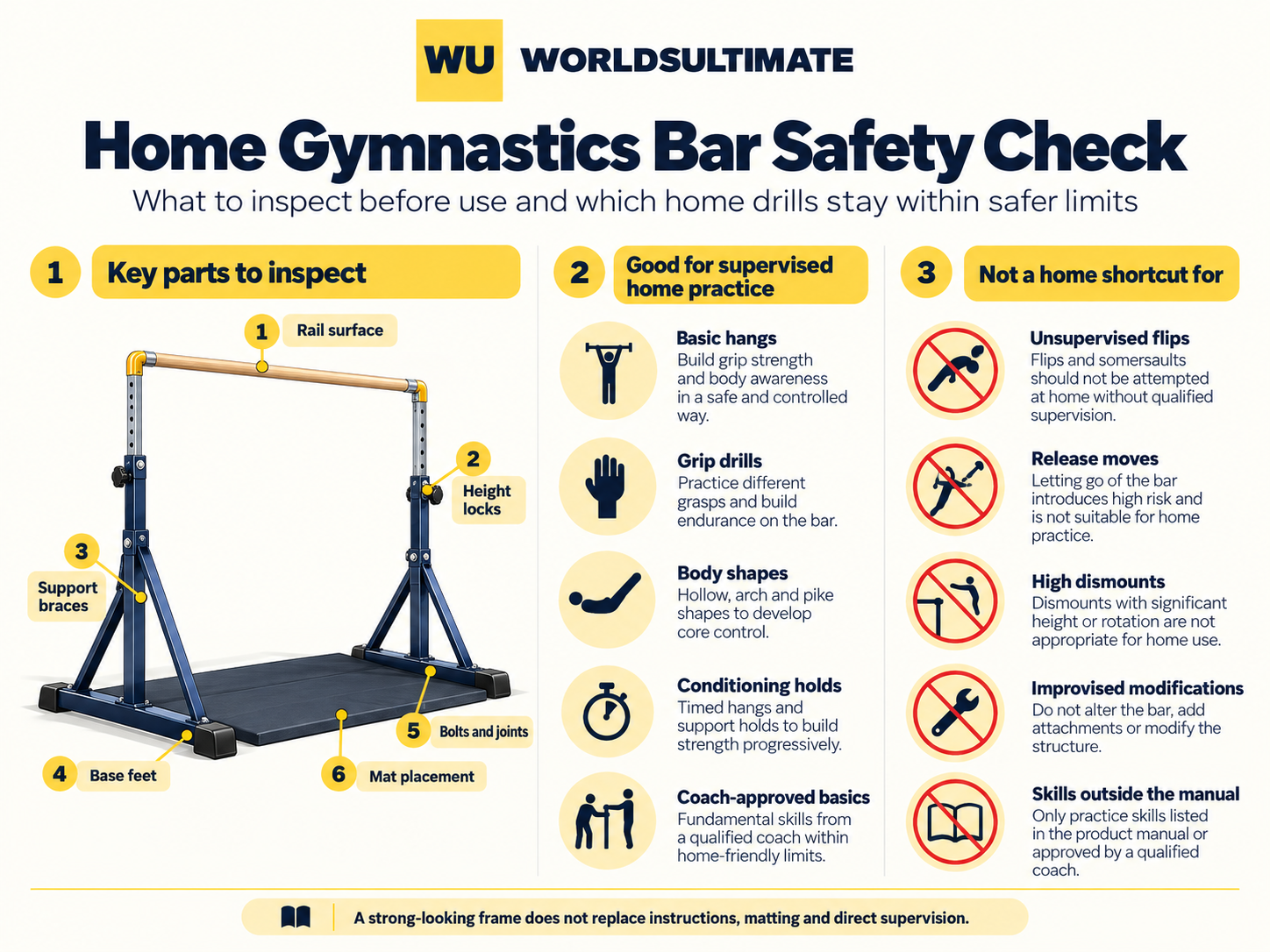
- Confirm model identification and assemble using its own instructions, not a similar-looking product’s video.
- Verify each structural tube, cross brace, bolt, height pin and foot is fitted exactly as specified.
- Confirm that the selected rail height is locked on both uprights.
- Measure overhead, front, rear and side space for the full intended motion.
- Use protective matting appropriate to the model, frame geometry and approved activity.
- Clear the area of other children, loose objects, furniture and overhead hazards.
- Check for unexpected rocking or joint movement and stop if detected.
- Keep direct adult supervision throughout every permitted drill.
- Put the equipment away or secure access when it cannot be supervised.
Which claims should not determine your purchase
Avoid ‘competition-quality’, ‘gymnastics grade’, ‘professional’, ‘FIG style’ or ‘safe for all ages’ as substitutes for documented specifications. A competition-looking rail may not have the same material, adjustment, anchoring or dynamics as club apparatus. Equally, a large quoted weight limit does not establish safety for more demanding skills.
Some guides suggest buying a bar two years ahead of the child’s current ability. That can be economical only where the exact frame remains appropriate for both current and future activities; no purchase guarantees that progress will follow a particular timeline. If the child trains primarily at a club, coaching feedback should determine whether any home bar is worth the floor space and supervision required.
Frequently asked questions
Are home gymnastics bars safe for beginners? They may support limited supervised basic exercises when equipment guidance and coaching agree. Beginner branding alone is not a safety guarantee.
Can children practise kips on any kip bar? No. The manufacturer must explicitly permit the relevant dynamic activity, and a coach should supervise skill progression.
What mat should go underneath? Choose protective equipment designed for the intended exercises, taking account of the maker’s requirements and a coach’s advice.