Two itineraries can both be called a Caribbean cruise yet deliver entirely different weeks. One spends its port days on beaches in St. Thomas and St. Maarten; another offers reefs and Maya sites around Mexico and Central America. A third reaches the Dutch Caribbean, with different distances and weather patterns. Choose the named ports and the days you can actually spend ashore before choosing a route label.
The short answer: Eastern Caribbean routes are often suited to beach and island-town days; Western Caribbean routes offer a mix of reefs, ruins and active excursions; Southern Caribbean sailings can reach Aruba, Bonaire, Curaçao and the Lesser Antilles, but the embarkation port and total duration matter. None of these labels guarantees calm seas, fewer crowds or a better price.
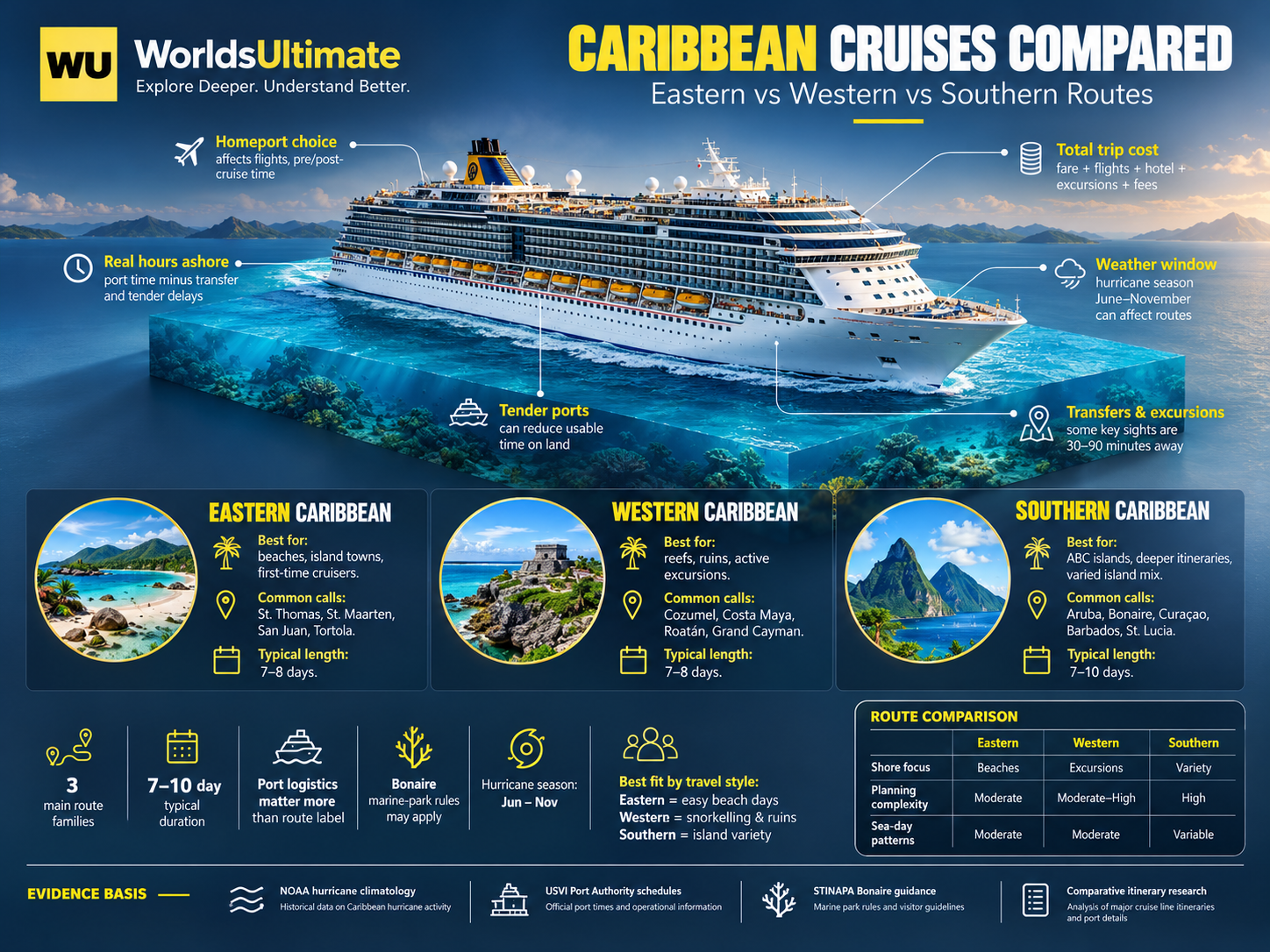
Free A4 PDF for offline reference. Route patterns are illustrative; verify your sailing’s actual ports and schedule.
Eastern vs Western vs Southern Caribbean: route comparison
| Route | Common calls | What to plan for | A good fit if… |
|---|---|---|---|
| Eastern Caribbean | St. Thomas, St. Maarten, San Juan, Tortola; some Bahamas calls | Port crowds, beach transfers and embarkation location | You want beach and island-town days with an established itinerary choice |
| Western Caribbean | Cozumel, Costa Maya, Roatán, Grand Cayman, Belize or Jamaica | Reef conditions, inland excursion travel and possible tendering | Your priorities are snorkelling, archaeology or active days |
| Southern Caribbean | Aruba, Bonaire, Curaçao, Barbados, St. Lucia and other southern islands | Journey length, flights to homeports, entry rules and port variation | You value a particular southern island more than a short round-trip |
These are typical geographic groupings rather than strict cruise-industry definitions. Bahamas-only itineraries, for example, should not automatically be counted as a Caribbean-island cruise just because a booking site groups them together. Cruise Critic’s regional destination guide and published operator route lists both show how much the actual port sequence varies. Compare actual ports and shore times on a dated itinerary.
Eastern Caribbean cruises: beaches, island towns and busy ports
If you are drawn to beaches and relatively straightforward day visits, an Eastern Caribbean itinerary may look attractive. St. Thomas offers a choice between the ship’s dock area, Charlotte Amalie and excursions farther afield. St. Maarten mixes beaches and two distinct national jurisdictions on the same island. San Juan is a city destination in its own right rather than just a departure port. The important question is not whether a stop has good beaches; it is whether your ship’s arrival and departure times make the beach you want practical.
St. Thomas alone demonstrates why a port name is not enough. The US Virgin Islands Port Authority distinguishes Crown Bay and Havensight cruise facilities and also describes tender operations for St. John. Check where your vessel is scheduled, whether other ships are in port, and whether you need a separate island transfer. Official USVI cruise-port schedules.
When the Eastern route disappoints
It is easy to choose a seven-night itinerary because several familiar islands appear on the map, then discover that a day at sea sits between major calls or that a beach visit needs a long taxi trip. Read the timetable line by line. Compare the number of genuinely useful port hours, not the total number of destination names. Where multiple large ships call together, a flexible plan can be more enjoyable than trying to reach the most photographed beach at the same time as everyone else.
Western Caribbean cruises: reefs, ruins and active excursions

Western Caribbean routes frequently visit the coast of Mexico, the Cayman Islands, Honduras and Belize. They can offer a more varied day ashore than a beach-only plan: Maya sites from mainland gateways, marine activities around Cozumel and Roatán, and visits to island towns. But the longest excursion on a brochure is not always the best use of a short call. Ruins may be several hours away by bus; popular snorkelling spots depend on water and weather conditions.
Tender operations are another practical difference. Some ports have berths for large vessels, while other calls can require transfer by boat. Grand Cayman is particularly important to verify on the itinerary: do not assume that the clock showing an eight-hour call means eight hours of free movement ashore. Ask about tender schedules, last return times, and accessibility before prepaying independent shore activities.
Choosing between Cozumel and Costa Maya
Cozumel is an island destination with beach, reef and nearby town options. Costa Maya is a mainland gateway whose best-known inland archaeological excursions can require substantial transport. If the primary reason to cruise is to see ruins, compare the exact site, travel time and time available at the attraction. If the priority is a swim and an unhurried lunch, the closer option may make more sense. The right answer depends on the call time and where the vessel actually berths.
Southern Caribbean cruises: why the starting port matters

Aruba, Bonaire and Curaçao are frequently grouped as the ABC islands, while Southern Caribbean itineraries can also include St. Lucia, Barbados, Dominica and other Lesser Antilles destinations. That name covers very different places; dry coastal environments and vibrant port towns are not interchangeable with lush volcanic island experiences. Pick the specific islands you want before deciding that all Southern Caribbean routes are equivalent.
A sailing departing from San Juan can reach a collection of islands with a different balance of sea days from a similar-length itinerary departing Florida. Longer Florida round-trips are also available. Cruise Critic’s published listings provide examples of both, but a listing is not a guarantee for your preferred dates. Compare flights, pre-cruise hotel needs, visa rules and the overall number of days away from home—not only nights onboard.
Bonaire: conservation rules affect your shore plan
In Bonaire, snorkelling or diving is not simply a matter of getting off the ship and entering the sea. The protected marine environment has visitor fee and access rules, which can vary by visitor category. Review the current requirements directly with STINAPA Bonaire before choosing an excursion. Local conservation protections are part of the destination, not a hidden inconvenience.
How to choose the best Caribbean cruise ports for your interests
| Your priority | Shortlist first | Check before committing |
|---|---|---|
| Beach time with limited planning | Eastern island routes | Beach transfer length, other ship arrivals and facilities |
| Reefs and marine activity | Western routes; Bonaire where accessible | Sea conditions, protected-area requirements and activity ability |
| Archaeology or inland culture | Mexico and selected mainland Western ports | Road transfers and useful hours at the site |
| Distinctive southern islands | ABC islands, St. Lucia and other Southern ports | Flights, sea days and exact island combinations |
| Low-effort family holiday | Itinerary with manageable transfers and suitable ship facilities | Child ages, excursions and total sea-day balance |
When to cruise: hurricane season and regional differences
The Atlantic hurricane season officially runs from 1 June to 30 November. The National Hurricane Center’s historical climatology places much of Atlantic storm activity between mid-August and mid-October, with a climatological peak around September. This is a regional planning fact, not a prediction that a particular sailing will encounter a storm. NOAA hurricane climatology.
The ABC islands sit relatively far south, and some guides describe them as lower-exposure options. That does not justify promising a storm-free holiday: your ship may pass through other waters, your flight or embarkation port may be disrupted, and even a distant weather system can alter schedules. Operators can reroute for safety, but the revised route may not deliver the ports you originally selected. Before booking in hurricane season, read the itinerary-change terms and insurance coverage carefully.
| Period | Potential advantages | Real trade-offs |
|---|---|---|
| December–April | Popular escape from cooler northern weather; broad itinerary choice | Holiday demand and variable crowding |
| May–early June | Warm conditions and options outside peak winter holiday weeks | Weather remains variable; hurricane season begins in June |
| Late June–November | Additional itinerary and pricing options on some departures | Tropical cyclone season, schedule changes and possible travel disruption |
The port-time test: compare two sailings fairly
Imagine one voyage calls at three islands for eight hours each. Another visits four destinations, but two require tender boats and one requires a long road trip for the excursion you care about. The second cruise has more destinations on the map but may give you less time to enjoy them. For each port, record the arrival and departure window, tender or shuttle time, outbound travel, return buffer and the activity you most want. Do not use exact transfer estimates from a different ship or season.
If travelling with children, older relatives or anyone with mobility limitations, pay particular attention to gangway access, boat-transfer requirements and long walks from the pier. The advertised ship accessibility features cannot establish that every shore outing is accessible. Ask for details about the actual ports and excursion vehicles.
Embarkation city, sea days and the full price
Cruises leaving Miami, Fort Lauderdale or Port Canaveral can offer straightforward flight connections for some travellers, but that does not mean they provide the easiest route to the Southern Caribbean. Sailing from San Juan may reduce some sea travel while adding a different flight, hotel or documentation requirement. Galveston and other Gulf-area homeports can make sense for travellers nearby, but include travel to the terminal rather than assuming that the nearest city is the most practical port.
A reliable comparison includes the fare and port fees, flights, ground transfers, pre-cruise accommodation, drinks, gratuities where applicable, shore excursions, marine-park fees, connectivity and insurance. The cheapest advertised cabin does not necessarily yield the cheapest holiday. For ship facilities and operator differences, consult our cruise-lines comparison; for a family group, use the family cruise-line guide.
Private islands are not the same as independent island calls
Some itineraries mix ports in established towns with cruise-line-operated private islands or destinations. A beach day with controlled facilities may be convenient, especially for families, but it provides a different type of experience from visiting a locally run market, historic quarter or public beach. Neither is automatically better. Check who operates excursions and amenities, which activities carry extra charges, and whether the destination is actually in the Caribbean or the nearby Bahamas.
Common mistakes when choosing a Caribbean cruise
- Treating every Eastern, Western or Southern route as identical instead of checking named ports.
- Choosing a cruise by fare alone while ignoring travel to its starting port.
- Assuming a port call means a full day ashore, even when tender transfers are involved.
- Planning a distant excursion without allowing time to return comfortably.
- Calling a southern route hurricane-proof instead of assessing the full journey.
- Confusing a private-island resort day with exploring an independent island community.
- Ignoring conservation fees and access rules at protected destinations.
The embarkation port can change the entire Caribbean holiday
Compare Miami and Fort Lauderdale, Port Canaveral, Galveston and San Juan as separate starting points. The closest port is not necessarily the best: an extra hotel night, a late flight, an inconvenient transfer or additional sea days can change both cost and time ashore. For Southern Caribbean islands, a San Juan departure sometimes permits a more port-rich week than a mainland departure, but the flight logistics may outweigh that advantage.
| Starting area | Common reason to choose it | Check before booking |
|---|---|---|
| Miami / Fort Lauderdale | Wide choice of ships and routes | Actual terminal, airport transfer, pre-cruise hotel |
| Port Canaveral | Combine a cruise with a Florida family trip | Airport-to-terminal journey and arrival buffer |
| Galveston / Gulf Coast | Potentially convenient Western Caribbean sailings | Sea-day pattern and ground transport |
| San Juan | Closer starting point for some Southern island routes | Flights, hotel, passport requirements and consecutive port days |
| Barbados and other island ports | Different island combinations on some seasonal voyages | Departure availability and international connections |
Five ports that show why route labels are not enough
St. Thomas: Crown Bay, Havensight or a St. John transfer?
The U.S. Virgin Islands Port Authority distinguishes Crown Bay from the Havensight cruise facility; visiting St. John can also involve a separate water transfer. Check the ship’s assigned berth rather than simply seeing “St. Thomas” in the itinerary. A taxi or island transfer arranged for the wrong dock can turn a relaxed beach day into a rushed one. The official cruise-port schedules explain the facilities and ship calls.
Grand Cayman: leave room for the tender
Grand Cayman calls commonly involve tender boats. When that’s the case, disembarkation and the last return boat reduce usable shore time. Ask the operator how tender tickets work and whether guests booked on independent excursions can realistically make their meeting time. Never plan to return from a distant activity at the ship’s departure time.
Cozumel versus Costa Maya: different Mexico days
Cozumel works for travellers interested in its island beaches, marine activities or town; Costa Maya serves a different mix of nearby coast and mainland attractions. An inland archaeological outing may be rewarding, but road time can consume most of a short port call. Compare the named attraction and the hours physically available there, not just a brochure photograph of ruins.
St. Maarten: two sides of the island
A St. Maarten call can take you beyond the cruise-port area to beaches and settlements on the island’s Dutch and French sides. Traffic, distance and return timing matter. A short visit is not a mandate to see both sides; choosing one area often leaves more time to enjoy it.
Bonaire: marine protection changes your plan
Bonaire is not simply another beach stop. STINAPA administers protected-area fees and marine-park rules. Its 2026 purchase portal lists a $40 annual nature tag with stated exemptions; separate destination guidance describes a one-day cruise-passenger option. Verify which category and fee apply to your visit before buying, and follow the protections against touching coral, feeding wildlife or collecting marine life. Check STINAPA directly.
Examples of seven-night Caribbean cruise patterns
These are illustrative route patterns, not bookable departures. The exact order, port hours, operating vessels and weather decisions change by sailing.
| Possible pattern | Good reason to choose it | Main trade-off |
|---|---|---|
| Florida → St. Thomas → St. Maarten → another island or Bahamas call → Florida | Island towns, beaches and a familiar first-cruise mix | Busy port days and variable sea-day count |
| Florida or Gulf Coast → Cozumel → Costa Maya or Roatán → Grand Cayman or Jamaica → return | Reefs, ruins and structured excursions | Tenders, transport and tight return timing |
| San Juan → a series of Lesser Antilles calls → southern island → San Juan | Distinct islands with potentially fewer long passages | Air travel plus demanding consecutive port days |
The full-cost test: an example, not a live fare comparison
Suppose Sailing A has an $800 fare, $350 in transport, a $170 hotel night and $400 in excursions and extras. The illustrative total is $1,720. Sailing B has a $1,050 fare, $150 in transport and $250 in extras, with no hotel needed. Its illustrative total is $1,450: $270 less despite the higher headline fare. These figures are invented solely to demonstrate comparison; they are not current prices or evidence that a named operator is cheaper.
Include taxes and mandatory charges, gratuities where applicable, ground transfers, pre-cruise accommodation, marine-park fees, excursions, drinks, internet access and insurance. Compare the same dates, travellers and cabin standard. Static rankings based on a single promotional fare cannot establish a universally best-value cruise.
Motion sickness, tender accessibility and children
Do not assume Western Caribbean sailings always have the calmest sea or that Eastern routes are inherently rough. Weather, sailing direction and individual sensitivity matter more than a simple map label. A large ship may feel different from a small vessel, but no route or ship can guarantee a motion-free voyage. Ask a qualified clinician about prevention if motion sickness is a concern.
For wheelchair users or travellers with limited mobility, a ship’s accessible cabin does not guarantee access to every tender port or shore excursion. Ask the operator about the specific gangway, tenders, mobility-device policy and local excursion vehicle for each named call. Families should similarly check the duration of bus journeys, availability of appropriate child restraints, shade and toilets.
Why experienced cruisers disagree about the ‘best’ Caribbean itinerary
Travel writers who have sailed the region repeatedly do not all choose the same route. Cruise Critic’s editorial comparisons and Sherri Eisenberg’s work for The Points Guy explain the general beach-versus-excursion distinction, while Scott Sanfilippo describes a personal preference for the Southern Caribbean based on years of travel. Scott S. Bateman’s Caribbean port writing places weight on individual calls. These are published third-party perspectives, not interviews conducted by WorldsUltimate, and personal preference should not be presented as an objective destination ranking.
What can be verified more directly is the operational evidence: USVI port schedules, NOAA’s hurricane climatology and Bonaire’s park rules. A particular ship’s timetable remains the final source for time ashore. Route names cannot guarantee weather, price, crowd levels or which wildlife you will see.
Frequently asked questions
Is Eastern or Western Caribbean better for a first cruise?
Both can suit a first cruise. If your main goal is beach and island-town time, start with Eastern routes. If snorkelling, ruins or excursions interest you more, compare Western itineraries. Then check exact departure ports, port times and ship facilities; those details matter more than the compass label.
Are Southern Caribbean cruises always longer?
No. Some southern island itineraries begin in San Juan or another Caribbean port and fit within a week; some sailings from mainland North America need more nights. Compare the actual homeport and sea-day allocation rather than assuming a fixed duration.
Which Caribbean cruise route is safest in hurricane season?
There is no route that eliminates weather disruption. Some southern islands have different historical exposure, but the ship’s passage, homeport and flights can still be affected. Check current forecasts, operator policies and insurance terms.
Which route is best for a family?
Choose manageable port days, suitable excursions and a ship with facilities appropriate to the children’s ages. An itinerary with fewer long transfers can be better than one offering more ports. See our family ship comparison for the onboard decision.
Further reading and sources
For a wider decision about where to travel, compare the Caribbean with Alaska, the Mediterranean and other regions in our worldwide cruise destinations guide. If you have chosen the region, our cruise packing checklist covers preparation. This guide draws on NOAA’s National Hurricane Center, the US Virgin Islands Port Authority, STINAPA Bonaire and published itinerary comparisons. It is an independent research synthesis; WorldsUltimate is not claiming to have personally travelled on every route. Port arrangements, safety conditions and scheduled calls change, so confirm current information for the actual sailing.