WORLDSULTIMATE · TRAVEL / WILDLIFE
Tiger Safari: Where Wild Tiger Viewing Is Actually Possible
A source-led investigation of tiger safari destinations in India, Nepal and Southeast Asia—what the population data shows, where tourism access is realistic, and which old 'best safari' claims need qualification.
TIGER SAFARI · CONSERVATION · WU MEDIA RECORD
01 · OVERVIEW
Start with wild-tiger habitat, not a promise of a sighting.
The useful part of the original article was its focus on India, Nepal and major tiger reserves. The weak part was treating every protected area as if it offered the same kind of tourist access and the same probability of seeing a tiger. India remains the centre of global wild-tiger conservation: the detailed 2022 All India Tiger Estimation reported an estimated 3,682 tigers, and NTCA says India holds about 70% of the world's wild tiger population. That does not mean every reserve is equally suitable for visitors or that any safari can guarantee a sighting.
Which places make sense for a genuine wild tiger safari?
For most travellers, the strongest combination of wild tiger habitat, regulated tourism and established safari infrastructure is in India. Ranthambore, Bandhavgarh, Corbett and Kanha are all recognised tiger reserves, but they differ greatly in landscape, reserve size, tourism zones and viewing conditions. Nepal's Chitwan National Park is also a significant Bengal tiger landscape, with Nepal's 2022 national assessment estimating 355 tigers and 128 in Chitwan and adjoining forests. By contrast, tiger strongholds in Thailand such as Huai Kha Khaeng are vital conservation landscapes but should not be marketed as if they provide the same routine tiger-viewing experience as India's safari reserves.
What does the conservation record actually show?
India's tiger story is larger than one park. NTCA's current reserve list includes Corbett, Kanha, Ranthambore, Bandhavgarh and many other reserves within a national network. Ranthambore is one of the best-known visitor landscapes, but the 282.03 km² national park is only part of a much larger tiger reserve. Rajasthan Tourism describes Ranthambore as a dry-deciduous landscape of hills, lakes and rivulets with strong opportunities for wild tiger viewing. Bandhavgarh is also famous for tigers and has a core made up of Bandhavgarh National Park and Panpatha Wildlife Sanctuary, but describing it as simply having 'the highest number of tigers in India' is too absolute. Kanha is a large central Indian tiger reserve of more than 2,000 km² including core and buffer, with sal forests, grasslands and important barasingha conservation. Corbett is one of the original Project Tiger reserves and combines riverine habitat, forest and grassland. The old article's destination list was therefore directionally useful, but the reserves need to be compared as different conservation landscapes rather than ranked by a single unverified claim.
What changes the chance of seeing a tiger?
Season, tourism zone, vegetation, water availability, recent animal movement, vehicle allocation, guide skill and simple luck all matter. The old article was right that hotter, drier periods can sometimes concentrate wildlife around water and make visibility easier in some Indian reserves, but it overstated this as a universal rule. Parks also have seasonal closures or restricted zones, and official booking calendars should be checked directly. A visitor should not assume that 'March to June' is automatically best everywhere, or that noon is the ideal viewing time. Tigers are wild animals with large territories and no obligation to appear on schedule. Multiple drives can improve opportunity, but they still do not create a guarantee.
What the record supports—and where it stops.
A concise conclusion, the evidence supporting it, and the uncertainty that remains.
The strongest tiger-safari destinations combine viable wild tiger populations, regulated visitor access and protected habitat; tiger abundance alone does not determine the quality or ethics of the experience.
NTCA population estimates and tiger-reserve records document India's major tiger landscapes. Nepal's Department of National Parks and Wildlife Conservation documents a substantial wild tiger population in Chitwan and other Terai protected areas. UNESCO identifies Thailand's Thungyai–Huai Kha Khaeng complex as a major tiger and large-mammal stronghold, but conservation importance should not be confused with routine tourist visibility.
Tiger numbers are estimates with confidence intervals, not exact live counts. Reserve populations and tourism zones change, sightings are unpredictable, and access rules vary by season and authority. This article does not endorse captive tiger attractions or close-contact wildlife experiences as substitutes for seeing wild tigers in protected habitat.
IN CONTEXTHabitat changes what a tiger safari feels like.
Open dry forest, sal woodland, riverine grassland and dense Southeast Asian forest can all support tigers, but they produce very different visibility and visitor experiences. A photograph proves that a tiger was present when it was taken; it does not prove current sighting probability.
A photograph can document visible conditions. It cannot establish cause, trend or risk without supporting records.
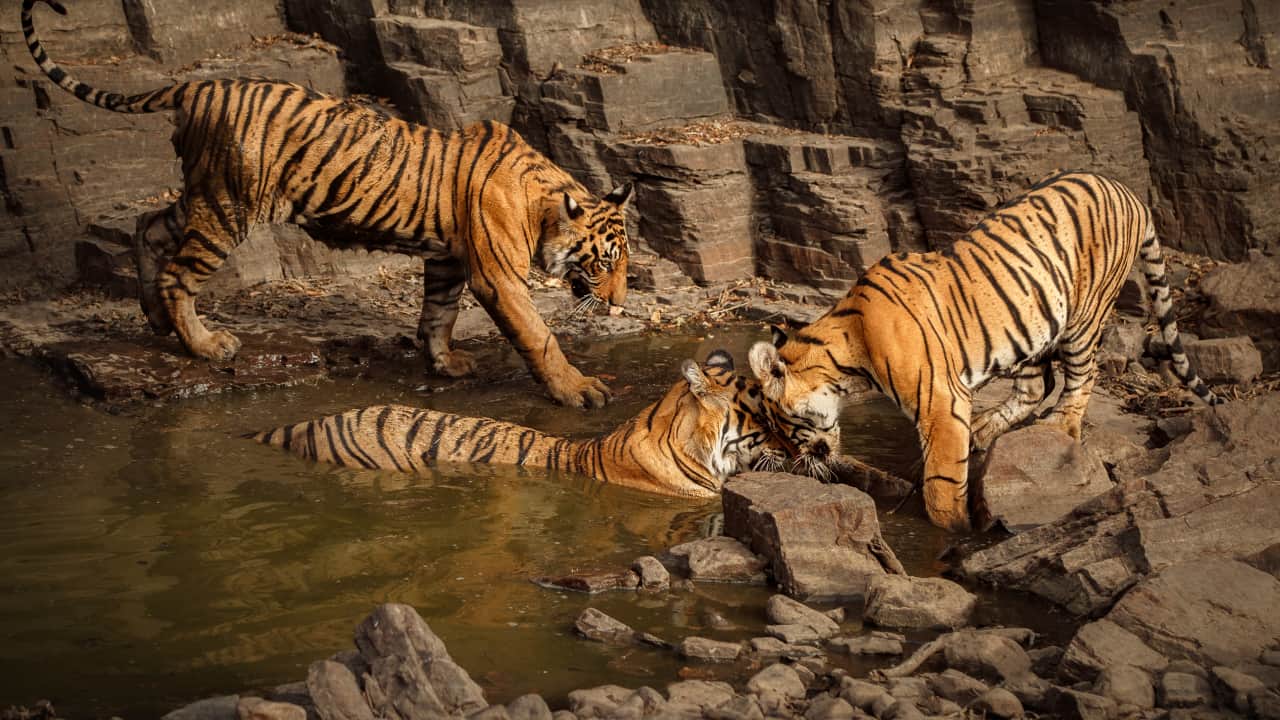
Ranthambore landscape
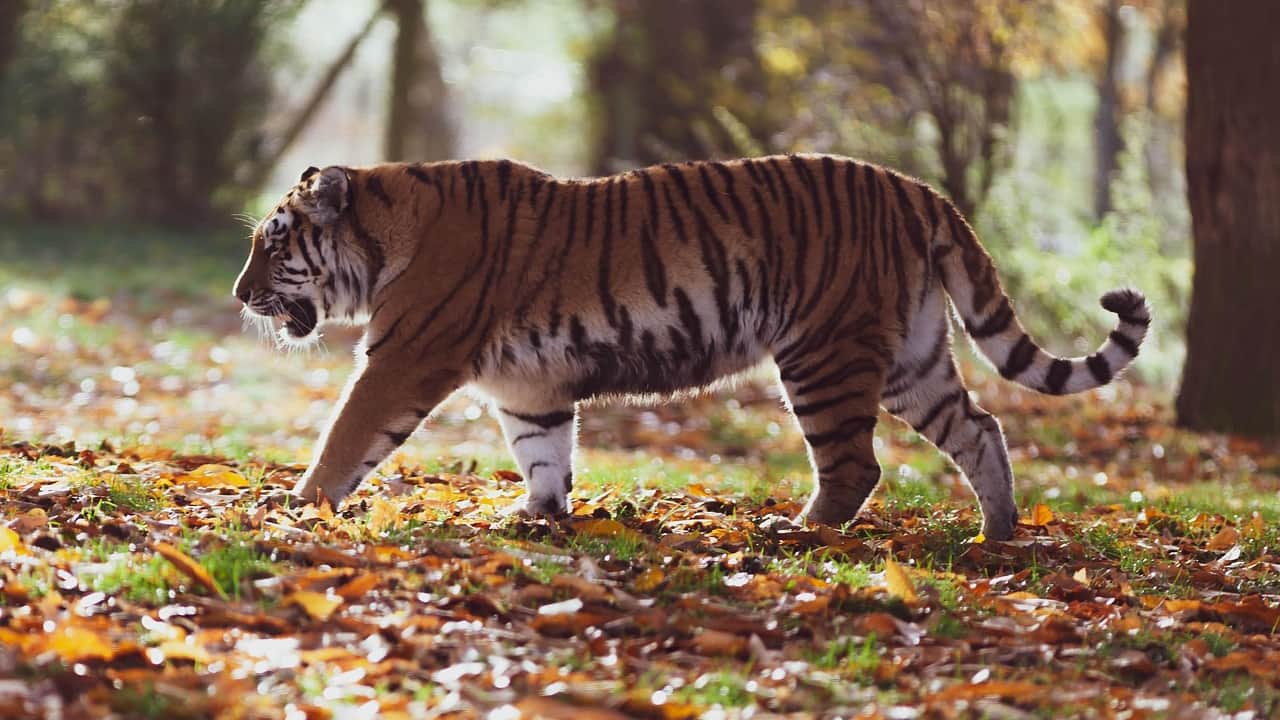
Bandhavgarh tiger habitat
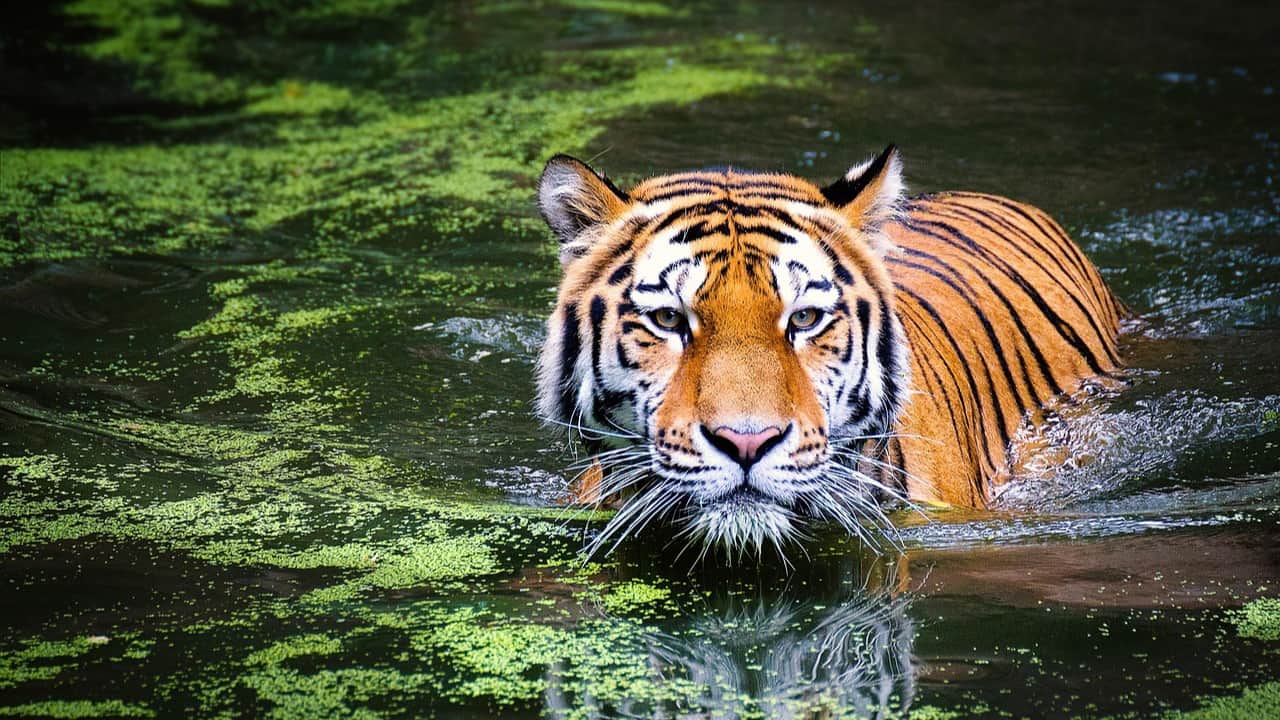
Tiger near water
EVIDENCE AND CONTEXT
What the record supports. And where it stops.
The older article had a good practical skeleton, so that depth is retained rather than discarded. Ranthambore remains a sensible first-time choice because it has established tourism, dramatic dry forest and a long public association with tiger viewing. The important correction is scale: the national park is about 282 km², while the tiger reserve is much larger. Bandhavgarh remains a major tiger destination, especially for travellers combining wildlife photography with central Indian forest scenery, but 'highest number of tigers in India' is not a stable or defensible label. Reserve-wide abundance, sampled density, tourism-zone visibility and current sightings are different measures. Corbett deserves its place because it is one of India's foundational tiger reserves and contains a wide habitat range, but its tourism zones and seasonal access need to be checked rather than summarised as one uniform park experience. Kanha is one of India's largest and most important central Indian tiger landscapes, with a strong conservation identity extending beyond the tiger to hard-ground barasingha and broader habitat management. Nepal should also stay in the article. Chitwan National Park and adjoining forests supported an estimated 128 tigers in Nepal's 2022 assessment, and the wider Terai landscape is an important Bengal tiger stronghold. A visitor there may combine tiger habitat with greater one-horned rhino and other wildlife, but tiger sightings are still far less predictable than marketing language often implies. Southeast Asia needs the biggest qualification. Thailand's Thungyai–Huai Kha Khaeng World Heritage property is a major conservation stronghold containing tigers and other large mammals, but dense forest and conservation priorities make it misleading to present it as simply another 'best tiger safari' equivalent to Ranthambore. For trip planning, the old article's practical advice also remains useful after correction. Book regulated safari access through the relevant authority or recognised booking system, especially where vehicle numbers and tourism zones are limited. Research the actual reserve rather than relying on generic tiger blogs. Learn the difference between core, buffer and tourism zones. Expect other wildlife to be part of the experience rather than treating every non-tiger sighting as a failure. Follow guide and reserve rules, keep noise down, stay within designated routes and never pressure a driver to chase, block or crowd an animal. Photography preparation is sensible—charged batteries, spare storage, binoculars and a suitable lens—but no photograph justifies disturbing wildlife. Clothing should be chosen for weather, dust and comfort; the earlier claim that bright colours can 'provoke the animals to attack' is not supported and has been removed. Local communities also matter. Many tiger reserves exist within wider human-used landscapes where livestock, agriculture, tourism and wildlife coexist. Responsible operators should follow reserve rules, avoid baiting or harassment, use authorised routes and communicate honestly that sightings are uncertain. Reviews can help assess logistics and guide quality, but conservation claims should be checked against the reserve authority rather than accepted as marketing. The clearest conclusion is that a tiger safari is not a checklist in which the trip succeeds only if a tiger appears. The evidence-based version is a visit to a functioning tiger landscape where conservation, habitat, prey, local communities and regulated tourism all determine what the visitor can responsibly experience.
Author and Reader Experience Editor at WorldsUltimate. Zaib Un Nisa Khalid is a clinical psychology postgraduate, writer and editor. She reviews reader clarity, language, human context and the responsible treatment of personal experiences while contributing across travel, lifestyle and human-behaviour topics.
The sources and context help explain what is known, what remains uncertain and where to read further.
Keep the investigation correctable.
National Tiger Conservation Authority · All India Tiger Estimation ↗
NTCA summary of the 2022 estimation, including the estimated 3,682 tigers and survey methodology.
National Tiger Conservation Authority · Tiger Reserves ↗
Official list and areas of India's notified tiger reserves, including Corbett, Kanha and Ranthambore.
Rajasthan Tourism · Ranthambore ↗
Official state tourism description of Ranthambore's habitat and wild tiger-viewing context.
UNESCO · Thungyai–Huai Kha Khaeng Wildlife Sanctuaries ↗
Documents the Thai World Heritage property's large-mammal diversity and importance for tiger conservation.
READER SIGNAL
Did this investigation answer the question?
ADD YOUR EVIDENCE
Your record can add missing context.
Include the place, date, what happened and a source editors can inspect. Submissions are moderated and do not automatically change the conclusion.
Audience submission · Add your evidence
Submit documented evidence
Your evidence enters a private moderation inbox. Automated spam and duplicate checks run first; a WU editor must then verify and approve it before it can appear publicly.