Good ski boots should hold your feet securely without causing persistent pain or numbness. Start with foot length, width and volume, then assess flex, skiing style and binding compatibility. Ordinary shoe size or a brand’s reputation cannot tell you whether a particular shell will fit.
For resort beginners: start with a snug but comfortable alpine boot that allows ankle movement. For more experienced skiers: focus on heel hold, shell shape and a flex that suits your technique. For touring: check uphill mobility and boot–binding compatibility before anything else. If you’re new to the slopes, see how to ski for beginners.
Ski boot selection at a glance
| What to check | Why it matters | Useful starting point |
|---|---|---|
| Foot length / Mondopoint | Sets the basic shell size | Measure both feet in centimetres |
| Width and instep volume | Controls pressure across the forefoot and top of foot | Consider the complete shape, not just last width |
| Flex | Affects how the cuff responds when you lean forward | Match your weight, technique and preferred feel |
| Boot type | Changes walking movement, weight and sole design | Resort alpine, touring or hybrid |
| Sole and binding interface | Necessary for safe retention and release | Have a technician confirm exact compatibility |
| Liner and footbed | Affect comfort, support and heel retention | Assess after shell fit is right |
Advice from a professional ski-boot fitter
Steve Cohen, co-founder of Masterfit Enterprises and a longtime organiser of ski-boot testing, advises skiers to take time over fitting and to match boots to their particular foot and leg shape—not simply to copy a friend’s preferred model. In his published fitting guidance, he also cautions against buying shells too large for initial comfort, since liners can become roomier with use.
The practical lesson is to measure both feet, assess the shell and instep, and spend enough time flexing in the boots to identify heel movement or pressure. Cohen’s advice supports professional fitting; it does not mean persistent pain or numbness should be tolerated.
How ski boots fit: snug is not the same as painful
Ski boots use a firm outer shell and an inner liner. A 2010 sports-engineering study of pressure distribution in ski boots examined three boots worn by six participants and found that assessing pressure over broad foot areas was more informative than relying on isolated points. The small study illustrates the importance of individual fit; it does not validate a particular boot brand or universal pressure threshold. A secure fit limits unwanted foot movement so pressure on the boot transfers predictably to the ski. Too much space can allow the heel to lift and force you to overtighten buckles. Too little usable room can create painful pressure, numb toes or poor circulation.
When standing upright in a correctly sized boot, your toes may brush the front of the liner. As you flex your ankles forward into a skiing stance, your heel should settle back and toe pressure often eases. The heel should stay controlled without the instep feeling crushed. Exact sensations vary with foot shape and liner design.
A practical fitting sequence
- Wear a thin ski sock rather than thick everyday socks. Measure both feet; fit should account for the larger or more difficult foot. For the rest of the clothing system, see what to wear skiing.
- Check length and shell fit with a qualified boot fitter, especially if choosing a performance-oriented shell.
- Buckle the boot with normal tension, flex forward repeatedly and confirm the heel stays seated.
- Stand for several minutes, crouch and check for sharp pressure, numbness, tingling or loss of circulation.
- Check both feet independently. Different foot shapes may need individual fitting adjustments.
A boot that feels pleasantly roomy in the shop can become too loose as the liner compresses with use. On the other hand, persistent pain is not a normal break-in requirement. Seek a boot fitter’s assessment instead of simply tightening the buckles further.
Mondopoint sizing explained
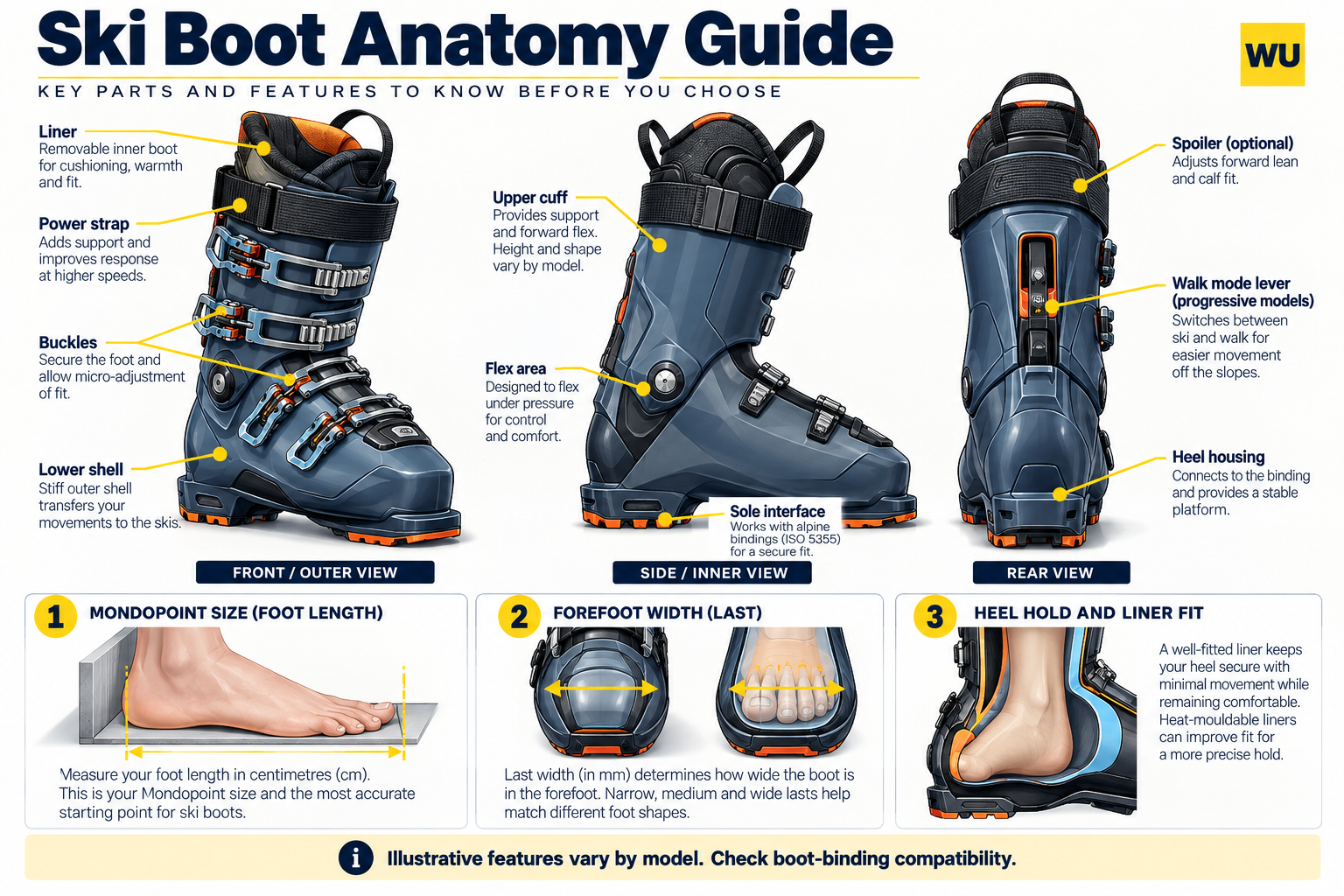
Ski boots commonly use Mondopoint sizing, related to foot length in centimetres. A foot measuring about 26.5 cm may be a starting point for a Mondopoint 26.5 fitting, but the measurement is not a guarantee of the correct shell. Toe shape, heel volume, liner thickness and the intended fit all affect the result.
| Foot length (approx.) | Mondopoint starting point | What to remember |
|---|---|---|
| 24.0 cm | 24.0 | Confirm shell length and fit |
| 25.0 cm | 25.0 | Widths differ between models |
| 26.5 cm | 26.5 | Half sizes may share shell moulds |
| 28.0 cm | 28.0 | Instep and heel hold also matter |
| 29.5 cm | 29.5 | Measure before converting from shoe size |
This table illustrates the measurement system, not a conversion guarantee. Many manufacturers use the same plastic shell for neighbouring whole and half sizes, changing the liner or footbed instead. Always check the actual boot and size chart before deciding.
What is a shell-fit check?
A professional can remove the liner, place the foot into the empty shell and assess the clearance behind the heel and around the forefoot. That helps separate a shell-size problem from pressure caused by a liner. The acceptable clearance depends on the intended fit and is best interpreted by an experienced fitter, not by a universal finger-width rule.
Last width, foot volume and instep height
The last is a manufacturer’s nominal forefoot width, usually stated in millimetres at a reference shell size. Typical ranges include narrower options around 97–99 mm, medium options around 100–102 mm and wider options above that, but the categories overlap and the measured width changes with shell size. A 100 mm label is not a promise that every part of the boot fits an average foot.
Volume is broader than width. Two feet with the same forefoot measurement can have very different arches, instep height, ankle circumference and heel shape. Excess instep pressure can cause discomfort even when the toes have space; a roomy heel pocket may cause lift in a boot that fits well across the front.
| Area | What a poor fit can feel like | What to assess |
|---|---|---|
| Forefoot | Squeezing around the ball of the foot | Width and shell shape |
| Instep | Pressure over the top of the foot | Boot volume and closure tension |
| Heel/ankle | Heel lifting during forward flex | Heel pocket, liner and footbed |
| Calf/cuff | Pinching or restricted stance | Cuff volume and alignment |
| Toes | Repeated impact or persistent numbness | Length, toe-box shape and stance |
Understanding ski boot flex ratings
A boot’s flex index describes its resistance when you press your shin forward against the cuff. A higher number generally means stiffer resistance within a manufacturer’s range, but the numbers are not standardised across brands and models. A boot marked 100 in one range may feel different from a 100 elsewhere, particularly in the cold.
A softer cuff may help some first-time skiers find a comfortable stance. Stronger, heavier or more aggressive skiers may prefer a firmer response for control. The correct choice also depends on body size, ankle mobility, skiing terrain and technique.
| General feel | Often considered by | Important caveat |
|---|---|---|
| Softer / more forgiving | Some beginners and lighter skiers | Too soft can feel unsupportive |
| Medium / balanced | A wide range of recreational skiers | Fit and individual build matter |
| Stiffer / more supportive | Some powerful or technically demanding skiers | Too stiff can prevent useful ankle flexion |
These are descriptions of feel, not a rigid flex-to-ability chart. Test the cuff in a skiing stance and discuss your weight, technique and preferred response with a fitter.
Alpine, touring and hybrid ski boots
Alpine resort boots
Traditional alpine boots prioritise reliable downhill control. They usually have a firm cuff, downhill-oriented closure hardware and a sole intended for compatible resort bindings. They are a logical starting point when your skiing is entirely lift-served.
Touring boots
Touring boots are designed to make uphill movement possible, often through a cuff walk mode, greater range of motion and lighter construction. Many use tech inserts for compatible pin bindings, though there are important exceptions and hybrid designs. Walk mode alone does not prove that a boot will work with your bindings.
Hybrid or freeride boots
Hybrid boots aim to balance downhill support with some uphill usability. Extra mechanisms and different soles introduce more compatibility checks. Skiers who switch between resort and touring equipment must establish whether each binding and boot pairing is approved.
Boot sole and binding compatibility: the essential safety check
Never assume any ski boot fits any binding. Traditional alpine boot soles, GripWalk-style soles and touring soles can have different shapes and standards. Release performance depends on how the boot interfaces with the binding, not merely whether it clicks into place.
ISO 5355 covers conventional alpine ski-boot interfaces. Improved-walking alpine soles are addressed by ISO 23223:2025, the current edition of that interface standard. GripWalk is one implementation; not every older alpine binding supports those soles. Touring soles and pin-binding fittings introduce other standards and manufacturer-specific limits. A shop technician should check the exact models, sole markings, wear and binding instructions and verify the release settings. Do not make unauthorised modifications to a boot sole.
Buckles, power straps, BOA closures and walk modes
Traditional buckles allow closure at multiple points over the foot and cuff. A power strap at the top can improve cuff contact. Some boots use dial-and-cable closure systems to distribute pressure across the lower shell, but neither buckle count nor a modern dial guarantees better fit.
Walk modes allow the cuff to move more freely when unlocked on suitable touring or hybrid boots. They must be placed in the correct position before downhill skiing according to the manufacturer’s instructions. Check mechanisms for wear, ice and damage as directed in the manual.
Liners, footbeds and professional adjustments
A liner provides cushioning and shape around the foot; some can be heat-moulded under controlled conditions. Footbeds support the foot inside the boot and may help stabilise the heel and manage pressure. A professional fitter may also assess liner shape, cuff alignment and whether the shell can be adapted to the foot.
Heat moulding, shell punching or grinding should only be done by someone equipped and trained for that model. Improvised heating or cutting can damage the shell, liner or fittings and may compromise the equipment.
Women’s, men’s and children’s ski boots
Product ranges described as women’s or men’s often differ in cuff height, volume distribution, sizing and nominal flex, but the label alone does not tell you which will fit an individual. Check anatomy, stance and range of movement. Children’s boots require particular care with sizing: oversized boots can reduce control, while rapidly growing feet need regular reassessment.
Young skiers should have bindings, boot size and equipment settings checked by a qualified technician. The ski-boot sole standards distinguish adult and children’s interfaces, so age and boot size alone do not establish whether the binding is suitable. Families comparing destinations can also consult our family ski resorts guide, including lessons and beginner-terrain considerations. Do not compensate for growth by choosing a shell so large that the child cannot control it.
Common ski boot fitting mistakes
- Choosing by everyday sneaker size alone rather than measured foot length and shell fit.
- Buying a loose boot because it feels comfortable during the first few minutes.
- Using very thick socks to fill unwanted space or overtightening buckles to stop heel lift.
- Assuming a high flex number means a better boot for every advanced skier.
- Mixing GripWalk, touring or alpine boots with bindings without checking compatibility.
- Ignoring persistent hot spots, numbness or changes in foot position after several days.
Care, drying and when to replace ski boots
After skiing, loosen closures and dry liners according to the manufacturer’s guidance. Avoid prolonged exposure to direct high heat, which can damage plastics and moulded components. Remove dirt and snow from sole interfaces and check that buckles, walk-mode mechanisms and fittings operate correctly.
Sole wear, cracked plastic, damaged lugs or loose components may affect the connection to bindings. Age alone does not set a universal replacement date: actual wear, materials, use and manufacturer guidance matter. Have questionable boots inspected before skiing.
Frequently asked questions
Should my toes touch the front of ski boots?
Light contact while upright can be normal in some correctly sized boots. It may lessen when you flex forward. Persistent pressure, curling toes or pain suggests a fitting problem.
Is a 100-flex ski boot suitable for a beginner?
Possibly, depending on body size, strength and the model’s actual feel, but there is no universal flex recommendation. A professional fitting is more reliable than choosing solely from the number.
Do ski boots need to be heat-moulded?
Not all boots require it. Some liners naturally settle with use; others are designed for controlled heat fitting. Follow the specific maker’s instructions.
Can I use GripWalk boots with older ski bindings?
Only if those exact bindings are approved for the sole system and properly adjusted. Ask a qualified technician to verify compatibility and release.
Do ski boots stretch over time?
The hard plastic shell does not stretch like casual shoes, but liners compress and settle. That can make the boot feel roomier after use, which is another reason to avoid buying oversized.
Are ski boots supposed to hurt?
They should hold the foot firmly, but sharp pressure, persistent pain, tingling or numbness are signs to reassess the fit.