Imagine carrying a jacket through a patch of woodland and finding twigs stuck to it before you have walked very far. Now imagine a jacket made almost entirely of things that can catch on twigs. That is one of the practical problems with a ghillie suit.
It is also part of what makes the garment distinctive. Instead of relying on a flat camouflage print, a ghillie suit has strips of cloth, yarn or other textured material hanging from its surface. The result can look remarkably like a tangle of vegetation. It can also be heavy, hot and difficult to keep clean.
So what is a ghillie suit actually good for? There is no single answer. A person sitting quietly to photograph wildlife needs something different from a person walking a long trail. And for many nature outings, a plain outdoor jacket is the more sensible choice.
The different types are not interchangeable
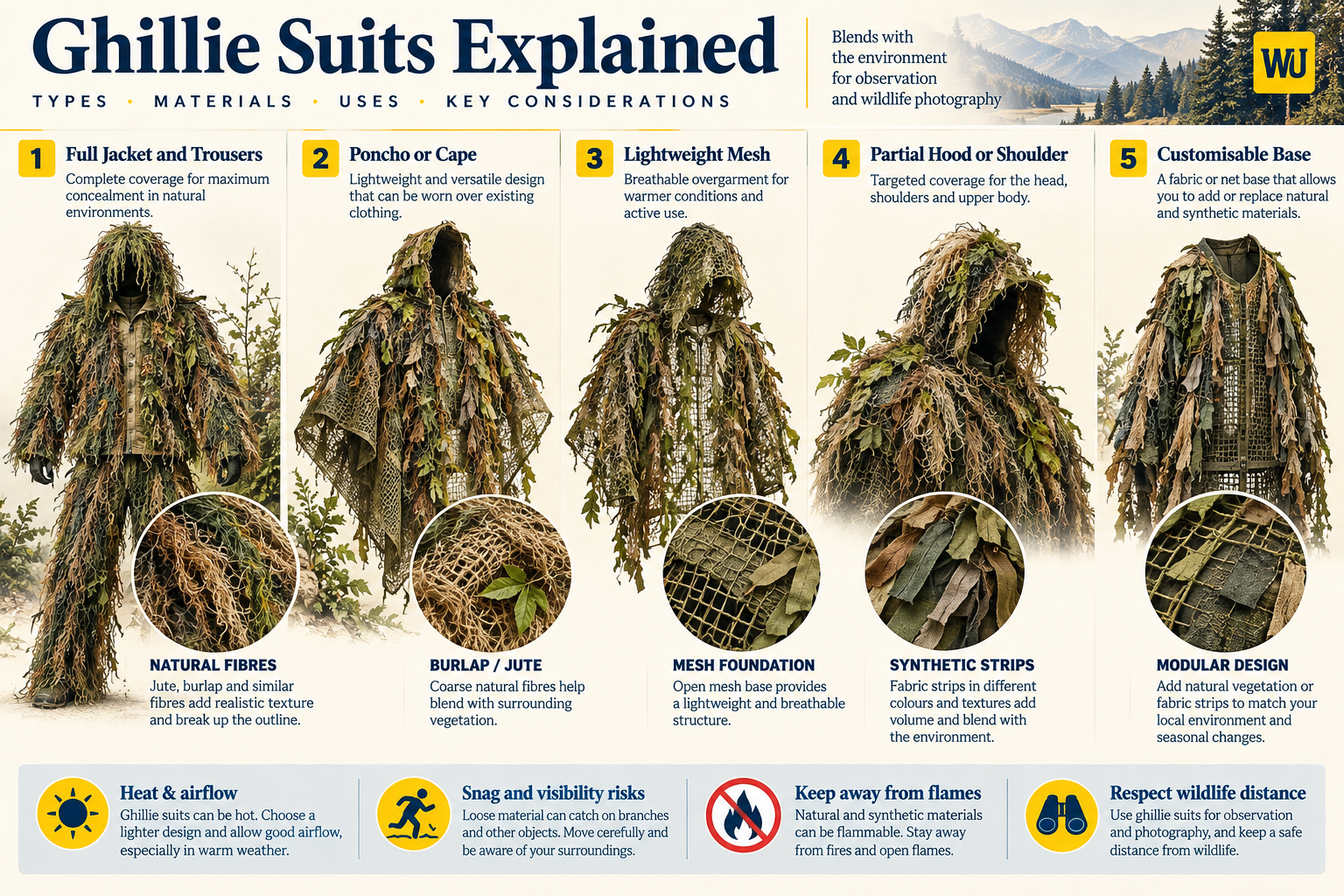
Photographs tend to make all ghillie suits look much the same. The differences become obvious when you look at what is underneath the fibres. Some are complete jacket-and-trouser sets. Others are ponchos, mesh overgarments or small shoulder coverings.
| Design | Construction | Practical trade-off |
|---|---|---|
| Full jacket and trousers | Textured outer layers over much of the body | Coverage but greater heat, snagging and bulk |
| Poncho or cape | Loose covering draped over outdoor clothes | Quick to remove but loose edges can catch |
| Mesh or lightweight overgarment | Net base with lighter attached strips | More airflow on some models; less weather protection |
| Partial hood or shoulder covering | Textured fabric over a smaller area | Less bulk but may limit hearing, sight or comfort |
| Customisable fabric foundation | Netting and replaceable textile pieces | Easy to repair, but workmanship and material safety vary |
There is no agreed consumer standard behind names such as “lightweight ghillie” or “woodland ghillie”. A lightweight design may simply have fewer attached strips. Another may have a more open mesh base. Check the construction and coverage instead of relying on the name.
Under all that texture, the material matters
The fabric base is easy to overlook. It holds the loose pieces together, takes the strain when you move and affects how the garment feels against other layers of clothing.
| Material | Useful property | What to check |
|---|---|---|
| Jute or burlap | Coarse natural texture | Weight when wet, shedding, fire behaviour |
| Polyester or nylon strips | Often lighter and quicker drying | Heat damage, melting, loose fibres |
| Mesh foundation | May reduce bulk and improve airflow | Tears, snagging, durability |
| Cotton blend | Soft fabric base on some designs | Moisture retention, drying time |
| Cordage, fasteners and stitched webbing | Holds the garment together | Loose loops, damaged attachments, abrasion |
Jute and burlap give a rough natural texture, but they can take on water and shed fibres. Polyester and nylon strips are common alternatives. They are often lighter, though heat can damage some synthetics. A loosely woven mesh base may allow more air through than solid cloth. Whether it actually feels cooler depends on the finished garment and what you wear beneath it.
Fastenings deserve a look as well. A loose cord can catch on a strap. Poorly attached fabric can pull away after repeated use. Neither a natural-fibre suit nor a synthetic one should be treated as flame-resistant unless the finished product has appropriate evidence to support that claim.
A museum coat tells an interesting story
The Smithsonian’s National Museum of American History preserves a ghillie suit belonging to US Army Specialist Christopher Horton. It is not a glamorous object once you look beyond the shaggy surface. Its construction involves a cloth foundation and painstakingly attached yarn.
In the museum’s account of the suit, curator Kathleen Golden describes the labour of adding those fibres, comparing it to hooking a rug. That comparison does more to explain the garment than a long list of camouflage marketing terms.
The name itself comes from Scotland, where ghillies were associated with guiding and estate work. The Lovat Scouts are part of the early military history of this kind of textured camouflage. Modern recreational suits borrow the general idea, although their materials and construction vary widely.
Does the extra texture make better camouflage?
It can change the way a person’s outline appears against the background. That is the basic distinction between a ghillie suit and a jacket printed with a camouflage pattern. Yet colour, light and vegetation are not fixed. Green fabric that seems plausible among summer leaves can look out of place when the ground turns brown.
There is another complication. The same material that breaks up an outline may get in the way of the activity you are trying to do.
Outdoor Life contributor Adam Moore compared ghillie and leafy garments in a published field review. He assessed their appearance against several backgrounds and whether the loose material interfered with his bow. In some cases, it did. Removing fabric from the sleeve helped with the interference.
That is a useful observation, although the test was limited to particular garments and one reviewer’s conditions. It cannot tell us that any design will perform equally well in a different landscape. It does show why photographs alone are a poor basis for judging a suit.
If you want to understand printed patterns as well, WorldsUltimate has a separate guide to camouflage types.
For wildlife photography, start with the animal—not the clothing
A photographer can spend a great deal of time thinking about whether a jacket looks like woodland. The animal has a different concern: whether it is being disturbed.
The US National Park Service advises wildlife photographers to use binoculars or telephoto lenses and to leave animals enough space. The National Audubon Society likewise stresses avoiding disturbance to birds. A ghillie suit does not change those responsibilities.
For a stationary observation session, a lightweight covering might be convenient where its use is permitted. But picture what happens when you need to lift a camera, adjust a tripod or find a lens cap. Every hanging strand is something else that can catch on your equipment.
On a long birdwatching walk, comfortable footwear, binoculars and quiet outer clothing may serve you better. There is no special benefit in wearing a suit if you spend the whole outing fighting its sleeves.
The problems begin when you move
Try kneeling in a full suit. Then stand up. Can you see your feet? Does the hem drag? What happens when you shoulder a backpack or reach into a pocket? These are simple checks, but they reveal more about everyday usability than a manufacturer’s posed photograph.
Dense vegetation adds another problem: snagging. Thorny branches and fences can catch loose strands. A hood that hangs over the sides of your face may limit peripheral vision. Neither is a good trade when you need to watch where you are stepping.
There is a reason to think carefully about temperature, too. Extra layers restrict airflow and may slow the loss of body heat, particularly in humid weather. The Occupational Safety and Health Administration identifies restrictive clothing as a contributor to heat strain in workplace settings. That guidance is not a test of ghillie suits, but the general clothing concern is relevant outdoors.
If a covering makes you uncomfortably hot, remove layers and rest somewhere safe. Dizziness, confusion or unusual weakness are signs to take seriously, not reasons to push on for another photograph.
Fire and visibility are not small details
Loose, untreated natural fibres may ignite near a campfire. Some synthetic strands may melt when exposed to high heat. Do not treat camouflage clothing as protective clothing simply because a product description uses the phrase “military grade”. The construction and documented tests would have to justify that claim.
Nor should concealment override human safety. In areas where visible safety clothing is required, wear it. Consider other visitors and any local hunting regulations. A suit that makes you less noticeable to wildlife can also make you less noticeable to someone who needs to see you.
Before choosing one, decide what the outing involves
There is little sense buying maximum coverage without considering where you will use it. The more useful comparison starts with the activity.
| Activity | Practical starting point | Why |
|---|---|---|
| Casual birdwatching | Comfortable outdoor layers and binoculars | Mobility, temperature control and wildlife distance matter most |
| Stationary wildlife photography | Long lens and unobtrusive clothing; optional permitted cover | Reduce disturbance without approaching wildlife |
| Warm-weather field observation | Light breathable clothing | Heavy coverings can retain heat |
| Walking through dense brush | Close-fitting garments with minimal loose attachments | Reduce snagging and maintain visibility |
| Areas requiring high visibility | Legally required visible clothing | Human safety takes priority over camouflage |
A portable wildlife blind is another possibility for stationary observation where it is allowed. Unlike a suit, it does not put loose fabric around your arms and legs. It brings its own size and carrying limitations, of course, and it does not give anyone permission to move closer to animals.
A ghillie suit needs more cleaning than a jacket
The loose surface collects things. Burrs. Seeds. Bits of grass. Sometimes enough debris to make inspection part of the outing’s end.
Remove stuck vegetation before you pack the suit away, then examine the stitching, ties and mesh. Follow the manufacturer’s cleaning instructions; vigorous machine washing may damage attachments. Let the garment dry fully before storage, away from flames and heaters.
Cleaning also helps avoid carrying seeds from one habitat to another. Leave living vegetation in place rather than collecting plants from a sensitive area to decorate your clothing.
The answer for most outdoor readers
A ghillie suit is a specialist piece of textured outerwear. Its appeal is easy to understand when you see one against a matching background. What is harder to judge from a photograph is the weight, the heat, the restricted movement and the work of looking after it.
For an occasional wildlife walk, I would start with ordinary outdoor clothing and good optics—not because a ghillie suit can never be useful, but because the simpler option addresses the needs of most such outings without introducing a new set of problems.
Frequently asked questions
Is a ghillie suit the same as a camouflage jacket? No. The defining feature is the raised texture from fabric, yarn or leaf-shaped attachments rather than a print alone.
Are mesh ghillie suits cooler? They may allow more airflow than thick cloth designs, but comfort also depends on layering, weather and how much material is attached.
Can a ghillie suit be used for birdwatching? Where permitted, yes. It does not replace patient observation, binoculars or a safe distance from wildlife.
Are ghillie suits fire-resistant? Do not assume that they are. Loose natural fibres can burn, and some synthetics can melt. Look for documented claims about the finished garment.
How should a ghillie suit be cleaned? Remove debris, inspect the attachments and follow its care label. Dry it thoroughly before storage.