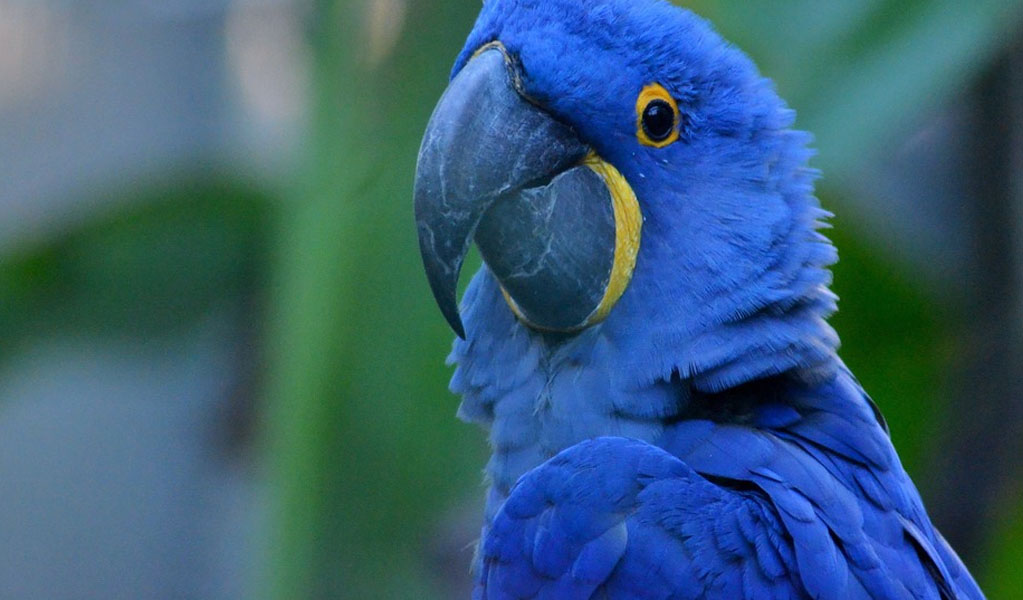
The Hyacinth Macaw (Anodorhynchus hyacinthinus) is the largest macaw species by length and one of the most recognizable parrots in South America. Its deep cobalt-blue plumage, black bill and yellow bare skin around the eye and lower mandible make it easy to distinguish from other “blue macaws.” It is not extinct: World Parrot Trust currently lists the species as Vulnerable, with an estimated 4,700–11,000 mature individuals.
If you are trying to identify which blue macaw you are looking at, start with the Types of Macaws hub. If your question is specifically whether blue macaws are extinct, use Are Blue Macaws Extinct?.
Hyacinth Macaw at a Glance
| Scientific name | Anodorhynchus hyacinthinus |
|---|---|
| Other common names | Hyacinthine Macaw, Blue Macaw |
| Length | About 90–100 cm (35–39 in) |
| Weight | About 1.2–1.45 kg |
| Range | Central South America: Brazil, eastern Bolivia and northern Paraguay |
| Habitat | Palm savannas, gallery forest, dry woodland and wetland-edge habitats |
| Wild diet | Mostly palm nuts, plus some fruit and molluscs |
| Conservation status | Vulnerable |
| CITES | Appendix I |
Why the Hyacinth Macaw Is Called a “Blue Macaw”
The name “blue macaw” is informal and can refer to several species. In this article, it refers specifically to the Hyacinth Macaw. That distinction matters because the Hyacinth, Glaucous, Spix’s and Blue-throated Macaws are different species with different ranges and conservation histories.
The Hyacinth Macaw is the largest of them. Its plumage is a rich blue with slightly darker wings, while the bare skin around the eye and the crescent-shaped patch beside the lower bill are bright yellow. World Parrot Trust gives a body length of 90–100 cm, and San Diego Zoo lists it as the tallest macaw species.
Where Hyacinth Macaws Live
Hyacinth Macaws occur in three separated parts of central South America. World Parrot Trust records populations from north-central to south-central Brazil, extending into eastern Bolivia and northern Paraguay.
They are not simply rainforest birds. Depending on the region, they use palm savannas, gallery forest, open dry woodland, wetland edges and areas with abundant nut-bearing palms. In the Pantanal, they are strongly associated with gallery forest and palm groves.
What Do Hyacinth Macaws Eat?
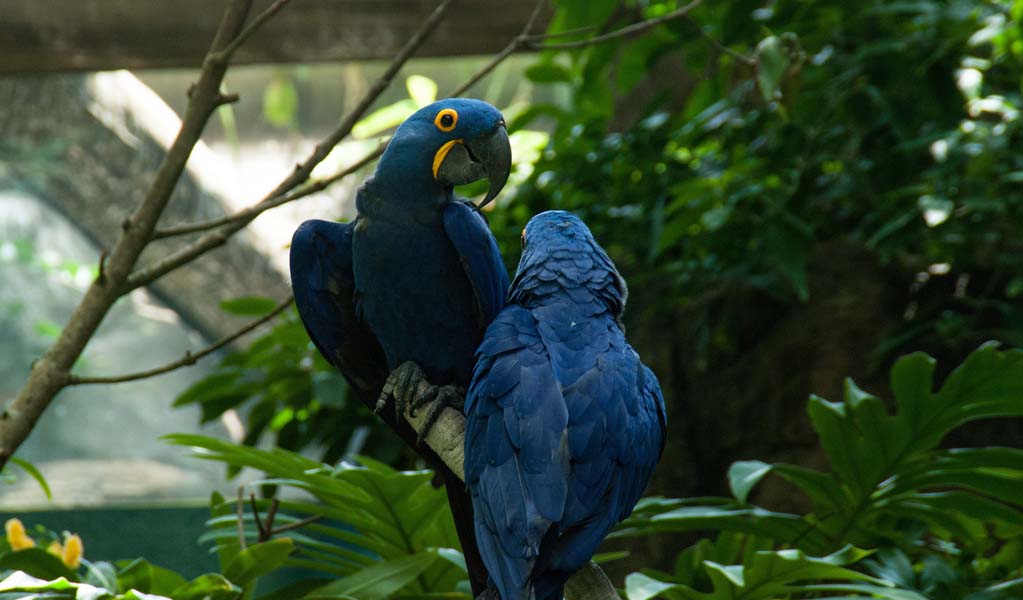
Palm nuts are the core of the wild diet. The exact palm species varies across the bird’s range. World Parrot Trust records Maximiliana, Orbignya and Astrocaryum in Amazonian areas; Scheelea and Acrocomia in the Pantanal; and Attalea funifera and Syagrus coronata in drier northeastern parts of the range.
Their massive bill is adapted to crack hard nuts that many other birds cannot open. WPT also records other fruits and Pomacea molluscs in the wild diet. For general husbandry information about captive macaws, use the separate Food for Macaws guide rather than treating this wild-species profile as a pet-feeding manual.
Behaviour and Breeding
Wild Hyacinth Macaws are usually seen in pairs, family groups or small flocks. Their calls are loud and harsh, and groups can be conspicuous when moving between feeding and roosting areas.
World Parrot Trust records a breeding season from roughly July to December. In the Pantanal and lower Amazon they usually nest in tree cavities; in northeastern Brazil they can also use cliff sites. A typical clutch is two eggs, although breeding success depends heavily on the availability of suitable nest sites.
Conservation Status
The Hyacinth Macaw is Vulnerable, not extinct. World Parrot Trust currently estimates 4,700–11,000 mature individuals and describes the overall population as stable. The species is also listed in CITES Appendix I.
That relatively stable picture follows a severe historical decline. WPT reports that heavy trapping reduced the population to roughly 3,000 birds between 1970 and 1990. Habitat loss, hunting and the loss of nest sites remain important threats.
Why Nest Sites Matter So Much
In the Pantanal, Hyacinth Macaws depend on large trees with suitable natural cavities. World Parrot Trust notes that only a small proportion of important nesting trees have cavities large enough for breeding. Young trees are also vulnerable to cattle browsing and fire, which can reduce future nesting habitat even when adult birds survive.
Conservation work therefore includes more than stopping trade. Current projects monitor nests, protect habitat, install nest boxes, support local communities and improve fire prevention and response.
Hyacinth Macaw vs Other Blue Macaws
| Species | Main distinction | Current picture |
|---|---|---|
| Hyacinth Macaw | Largest; deep cobalt-blue; yellow eye-ring and lower-bill patch | Vulnerable; survives in the wild |
| Glaucous Macaw | Paler blue-grey; historically southern South America | Possibly extinct |
| Spix’s Macaw | Smaller, grey-blue head and body | Extinct in the Wild, with captive and released birds |
| Blue-throated Macaw | Blue upperparts with yellow underparts and a blue throat patch | Still survives in Bolivia, highly threatened |
For the full species map, return to Types of Macaws.
Sources and Limits
This revision uses specialist wildlife sources rather than general pet or lifestyle pages. The main references are the World Parrot Trust Hyacinth Macaw species account, the World Parrot Trust conservation project, and the San Diego Zoo macaw overview.
Population estimates and conservation status can change as new surveys are completed. The article should therefore be read as a dated species profile, not a permanent population count.