The Glaucous Macaw (Anodorhynchus glaucus) is a large blue-green South American macaw that has not been reliably recorded in the wild for decades. The World Parrot Trust lists it as Critically Endangered (Possibly Extinct), with no verified surviving population. Its story is best understood through historical records, museum specimens, habitat evidence and the limits of what can still be confirmed.
If you are comparing this bird with other blue macaws, start with our Types of Macaws hub. For the broader question about which blue macaws are extinct or still surviving, use Are Blue Macaws Extinct?
Glaucous Macaw at a Glance
| Scientific name | Anodorhynchus glaucus |
|---|---|
| Genus | Anodorhynchus |
| Approx. length | About 72 cm (28 in) |
| Historic region | Southern South America, especially the Paraná–Uruguay river system and Corrientes, Argentina |
| Habitat | River-edge woodland, lightly wooded grassland, marshes and palm-rich savanna |
| Food best supported by records | Nuts of the yatay palm (Butia yatay) |
| Current status | Critically Endangered (Possibly Extinct) |
| CITES | Appendix I |
Is the Glaucous Macaw Extinct?
The careful answer is possibly, but not formally confirmed as extinct. World Parrot Trust records only two reliable twentieth-century reports: a direct observation in Uruguay in 1951 and a later report from Paraná in the early 1960s. A 1999 survey of historical habitat in Brazil found no birds. The Trust therefore describes the species as feared extinct in the wild and lists the population as likely none.
Later local reports exist, but they are not the same as a verified modern population. That distinction matters. A species can remain listed as “Possibly Extinct” while conservationists continue to allow for the chance that a tiny remnant population has escaped detection.
World Parrot Trust’s Glaucous Macaw Search is the clearest current summary of the search history and the limits of the evidence.
What Did the Glaucous Macaw Look Like?
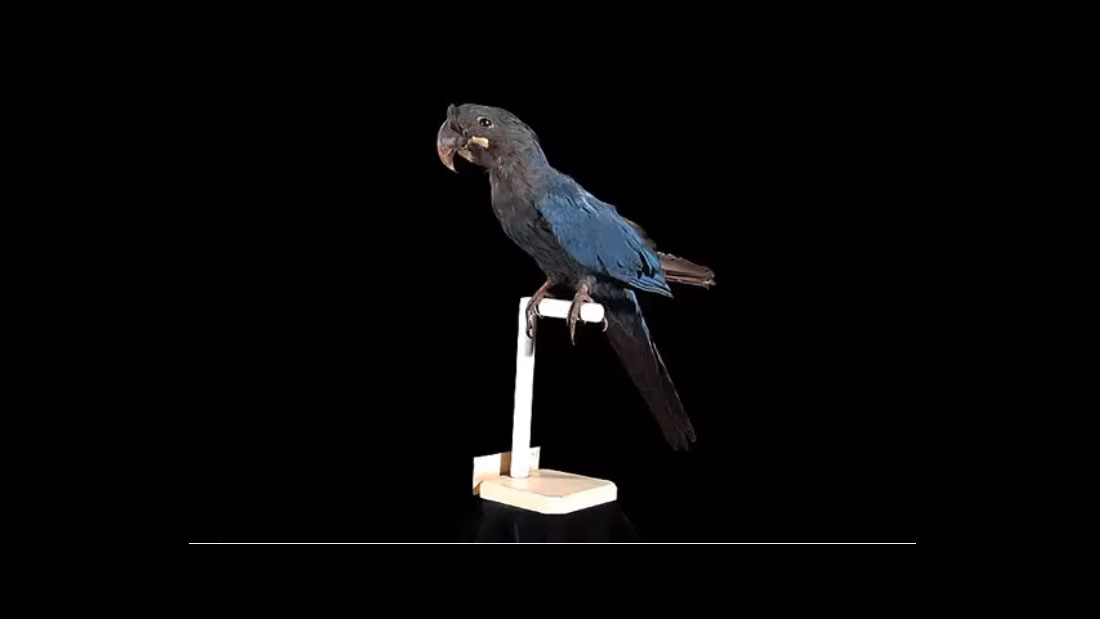
The species was large and long-tailed, with blue-green plumage rather than the deeper cobalt tone of a Hyacinth Macaw. Historical descriptions note a greyer head and neck, a dark bill, a yellow bare eye-ring and pale yellow skin at the base of the lower mandible.
The World Parrot Trust gives a length of about 72 cm and notes that the weight of the species was not recorded. Juvenile plumage and the call are also listed as not recorded. That is more useful than filling those gaps with assumptions from other macaws.
Historic Range: What the Records Actually Support
The strongest historical records cluster around the major river systems of southern South America, particularly the middle reaches of the Uruguay and Paraná rivers and the Corrientes region of northeastern Argentina. Older accounts also place the bird around parts of southern Brazil and Uruguay.
Paraguay is less straightforward than many older summaries suggest. The World Parrot Trust’s current species account notes that evidence for occurrence in Paraguay is no longer considered valid, while older literature linked “Guaa obi” records to the Paraguay River. A later review of Paraguayan macaws found that some early reports may have confused the Glaucous Macaw with the larger Hyacinth Macaw. That is exactly the kind of historical uncertainty this page should preserve rather than smooth over.
For the historical-source discussion, see the peer-reviewed review Status and distribution of Paraguayan macaws.
Habitat and Diet
Available records point to river-border habitats, lightly wooded grasslands, marshes and palm-rich savannas. The bird appears to have been closely associated with yatay palms (Butia yatay), whose nuts are the best-supported food item in the historical record.
This close relationship with palm-rich habitat may help explain why landscape change was so damaging. Clearing, settlement and agricultural conversion reduced both feeding habitat and the broader riverine landscape on which the species depended.
Why Did the Glaucous Macaw Decline?
- Habitat destruction and degradation: settlement and agricultural change altered the major river basins within its historical range.
- Loss of palm habitat: decline of palm-rich areas reduced an important food resource.
- Hunting and capture: historical records indicate pressure from hunting and the wild-bird trade.
- Small remaining population: once numbers became very low, finding mates and recovering from local losses would have become much harder.
World Parrot Trust identifies habitat degradation, hunting and capture for trade as the major documented pressures. We should be cautious about adding disease, predation or precise reproductive failure claims unless a source documents them specifically for this species.
What We Do Not Know
The gaps are unusually important here. Reliable modern field data are almost nonexistent. World Parrot Trust lists the call, weight, clutch size and fledging age as not recorded. Breeding behaviour is inferred mainly from related macaws and historical observations rather than a modern study population.
That means claims such as an exact wild lifespan, a precise incubation period, detailed captive-health profile or sophisticated social behaviour should not be presented as established Glaucous Macaw facts. The absence of data is part of the evidence.
Was the Glaucous Macaw Kept in Captivity?
Yes, but only in very small numbers historically. World Parrot Trust records that the last known captive specimen died in Buenos Aires Zoo in 1938. There is no credible modern captive population from which normal pet-care advice or lifespan statistics can be derived.
What Is a Glaucous Macaw Worth?
There is no credible modern market price for a Glaucous Macaw. The species is possibly extinct, has no verified current captive population, and is listed in CITES Appendix I. Claims offering a modern Glaucous Macaw for sale should therefore be treated with extreme caution rather than used to create a price guide.
Glaucous Macaw vs Other “Blue Macaws”
“Blue macaw” is a colour description used loosely for several different birds. The Glaucous Macaw is not the same species as the Hyacinth Macaw, Spix’s Macaw or Blue-throated Macaw. They differ in genus, range, size, conservation history and appearance.
- Glaucous Macaw: Anodorhynchus glaucus — possibly extinct.
- Hyacinth Macaw: Anodorhynchus hyacinthinus — extant and much larger.
- Spix’s Macaw: Cyanopsitta spixii — subject of reintroduction work.
- Blue-throated Macaw: Ara glaucogularis — survives in Bolivia in very small numbers.
For the full taxonomy and links to WU’s individual species pages, return to Types of Macaws.
Sources and Limits
This revision prioritizes specialist and primary-style records over generic pet websites. Key references include the World Parrot Trust species account, the 1999 search project summary, and the Uruguay Ministry of Environment’s Red Book of the Birds of Uruguay.
The core conclusion remains deliberately limited: the Glaucous Macaw is a historically documented South American species with no verified modern wild population. Anything stronger should wait for stronger evidence.