Free-standing pull-up bars are safe only for the movements, users and installation conditions their manufacturers specify. Before exercising, check the frame’s footprint and stability, permitted loads, floor conditions, ceiling clearance and locking mechanisms. A station that supports a controlled pull-up is not necessarily suitable for swinging or muscle-ups.
A basic pull-up station, a multifunction power tower and a larger training rig are not interchangeable. This guide explains their practical differences without recommending brands or commercial product lists.
Free-standing pull-up bar types at a glance
| Frame type | Common arrangement | Main consideration |
|---|---|---|
| Pull-up station | Bar above a floor-standing frame | Clearance and permitted load |
| Power tower | Bar plus dip or knee-raise stations | Changing loads and base stability |
| Power rack or training rig | Larger multifunction structure | Installation and anchoring requirements |
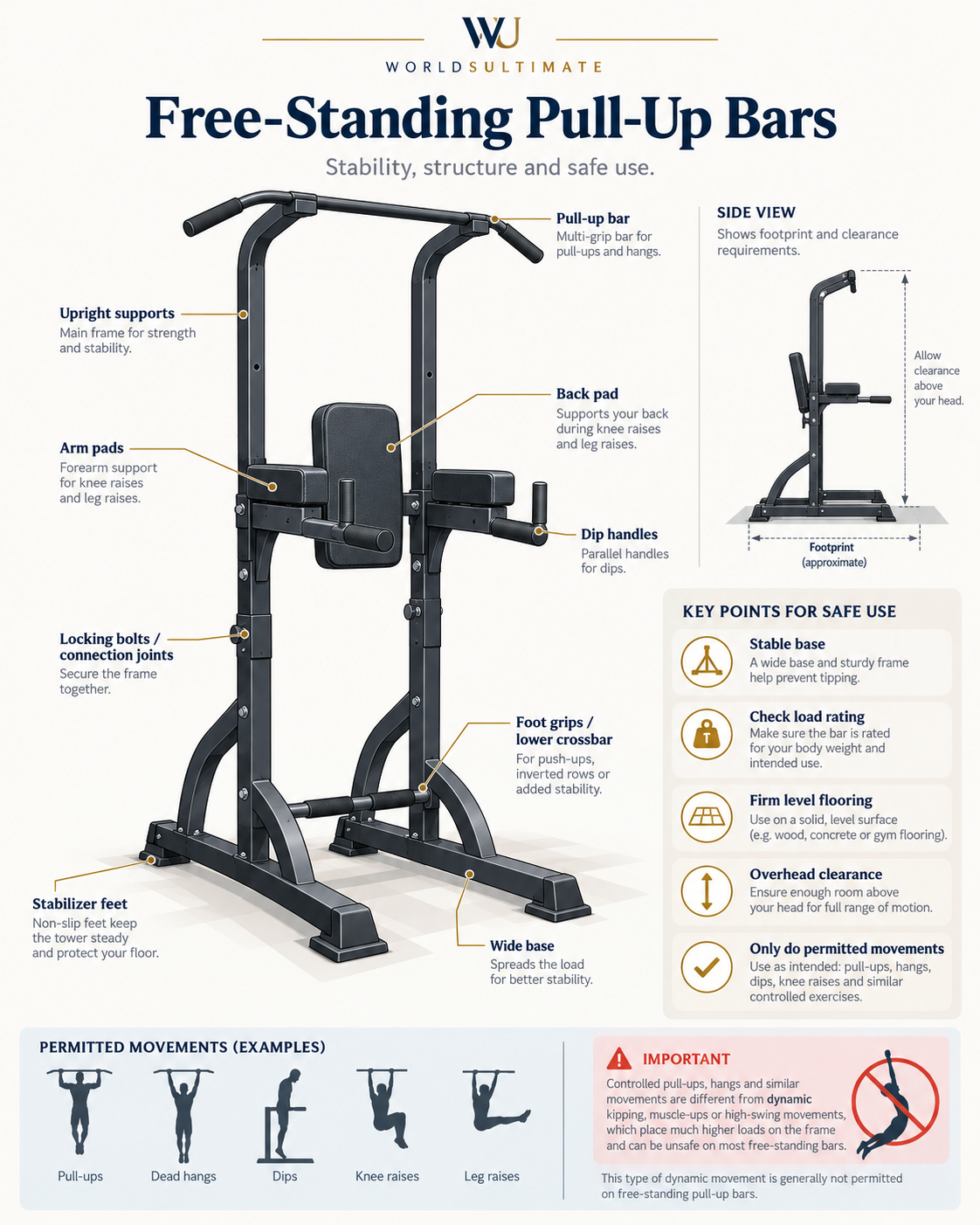
Types of free-standing pull-up bars
A basic freestanding station supports an overhead bar on upright legs and a floor base. A power tower usually adds dip handles or a supported knee-raise station. Larger training rigs and power racks use different structures, sometimes requiring permanent anchoring. The name or appearance alone cannot establish what movements the frame permits.
For ordinary home use, the practical questions are whether the station fits your space, whether the bar height suits the users, and whether the manufacturer authorises your intended exercises. Foldable models must be fully opened and locked before use.
Why frame stability matters
A still person hanging from a bar places a different pattern of forces on the equipment than someone who jumps into a grip, swings their legs or performs a fast transition. As body position changes, the centre of mass may shift beyond the footprint of the base, increasing rocking or tipping risk.
A wide base can help stability but is not proof against tipping. Uneven floors, thick carpets, worn feet, loose joints and unapproved attachments can also affect stability. Stop use if the frame moves in an unexpected way.
Static versus dynamic load ratings
A stated maximum user weight should always be read alongside the maker’s permitted movements and installation conditions. It may describe a controlled use case, not kipping, swinging or muscle-ups. Never assume that adding weights to the base or improvising braces turns an unsuitable frame into a suitable one.
The ISO 20957-1:2024 standard describes general safety requirements and test methods for indoor stationary training equipment, including domestic class H equipment. It is not evidence that any particular station is certified. Equipment-specific standards may add requirements, and the general standard has limitations regarding equipment intended for children under 14.
Room dimensions and clearance
Measure the full footprint, height and the area through which the user’s body will move. A person’s head can rise above the bar during a pull-up, so the ceiling cannot be assessed using bar height alone. Keep adequate clearance from ceiling fans, beams, glass, doors, furniture and other people.
Check whether the specified floor must be level and firm. Loose foam mats and thick carpet may cause some stations to move. Follow the manual’s anchoring and placement requirements rather than assuming every freestanding model can be used without securing it.
Grip diameter and bar position
Bar diameter, surface texture and grip placement affect comfort and exercise technique. The safest grip is one that the user can control on equipment intended for the exercise. Inspect bar coatings and grips for looseness or sharp damage.
Our pull-up bar diameter guide explains common grip considerations. A larger selection of handles does not necessarily make a frame more versatile if the movement required exceeds its limits.
Which exercises are appropriate?
Controlled hanging and regular pull-ups can be appropriate on equipment specifically designed for them, provided the person has the capacity and uses sound technique. Some power towers also allow supported knee raises and dips, but these change the direction of forces on the frame and may have separate restrictions.
Kipping, repeated swinging and muscle-ups should not be attempted on household stations unless the exact manufacturer instructions explicitly permit those movements in the installed configuration. A frame that feels secure during a controlled hang can behave differently under dynamic loading.
The American College of Sports Medicine’s 2026 resistance-training position stand supports exercise progression suited to an individual’s training status and goals. It does not establish the safety of any particular pull-up station. See WU’s pull-up exercises guide for movement descriptions, subject to your equipment’s limits.
Assembly and inspection
Follow the full assembly order, secure adjustment pins and folding locks, and use only manufacturer-approved components. Inspect bolts, welds, handles, joints, feet and the bar for cracks, corrosion, deformation or looseness before sessions. Do not continue training on an unstable or damaged frame.
Keep bystanders away from the exercise area. Observe any age restrictions. A product marketed as home fitness equipment is not automatically appropriate for unsupervised children or gymnastics-style skills.
Free-standing, doorway and wall-mounted bars
A free-standing station avoids drilling on models designed to be used without anchoring, but occupies floor space and must resist tipping. Wall-mounted bars may save space but depend on a suitable structure and secure installation. Doorway bars are compact yet depend on doorframe fit and the attachment mechanism.
Each approach has its own limitations, so choose based on the structure, permitted movements and installation instructions. WU also explains DIY pull-up bar construction considerations; homemade load-bearing equipment needs competent structural design rather than assumptions based on appearance.
What an experienced trainer looks for
Steve Hoyles, a certified personal trainer, weightlifting coach and gym owner, has reviewed free-standing pull-up stations with particular attention to rigidity, floor footprint and how firmly a frame remains planted during demanding repetitions. His published assessment of dedicated stations also emphasises the trade-off between a substantial base and the room it occupies.
For home use, those observations lead to a practical check: measure the whole exercise area, confirm the frame’s approved movements and do not interpret a reviewer’s stability impression as proof that a station is safe for kipping or muscle-ups. Hoyles’ equipment comparisons include affiliate links; his views are independent of WU and are not an endorsement of this article.
Choosing the right station for your room and training
First decide whether you need only controlled pull-ups or also want dips and supported knee raises. A basic bar station can be sufficient for vertical pulling; a power tower provides additional stations but occupies more room and may introduce more joints to inspect. A rack with an integrated bar is worth considering only if you already have space and a separate need for rack-based exercises. There is no reason to buy the largest frame simply because it has the longest exercise list.
| Your situation | Practical priority | What to avoid |
|---|---|---|
| Rental or a room where drilling is prohibited | A freestanding model intended for unanchored use | Assuming every freestanding rig can remain unsecured |
| Low ceiling | A bar height that leaves head clearance at the top of a repetition | Measuring only the assembled frame height |
| Multiple household users | Approved adjustment range and positive locking pins | Loose telescoping joints or unapproved settings |
| Training dips and knee raises | A tower specifically rated for those stations | Assuming the pull-up rating applies to all handles |
| Weighted strict pull-ups | Verified total permitted load including added weight | Treating bodyweight-only limits as sufficient |
| Explosive calisthenics | Equipment explicitly approved for the exact skill and installation | Assuming a stable dead hang proves muscle-up suitability |
Adjustable height and reach: what to measure
An adjustable bar is useful only when every chosen height is a permitted, securely locked configuration. Check both the lowest usable position and the maximum working height. The frame must leave enough space to enter, hang and finish a controlled repetition without striking the ceiling. If your feet touch the floor while hanging, you may need to bend the knees, but do not improvise exercises outside the equipment instructions.
If several people will share the station, confirm that changes between heights can be made safely and that locking pins cannot remain partially engaged. Set the height with the frame unloaded. Reachability should be considered separately from overhead clearance: a shorter user may need a safe way to approach the bar, but an unstable stool should not be used as a step during training.
Stability features: what to inspect on a frame
Look at how the uprights connect to the base, whether the support feet sit flat, where cross-braces are fitted, and how adjustable joints are secured. Steel thickness and frame weight can affect behaviour, but neither is a universal substitute for movement-specific testing. Some frames use rear feet, angled supports or a longer front-to-back base to help resist rocking; the effective arrangement depends on where forces act.
The full ISO 20957-1:2024 safety framework includes stability testing and requirements for exposed edges and accessible parts. The publicly accessible standard information describes its scope; it does not certify any specific unit. A manufacturer’s documented test and instructions are more informative than unsupported claims of being ‘professional’ or ‘commercial grade’.
Grips, hands and shoulders
Straight, angled and parallel grips position the hands and forearms differently. A neutral grip may feel comfortable to some users, but no grip style is universally optimal. Bar diameter, surface texture, usable width and how far handles project from the supporting frame all affect the experience. Sharp knurling and rotating or poorly fitted grips may introduce unnecessary problems.
A peer-reviewed study of 11 participants comparing three pull-up techniques found different patterns of shoulder muscle loading between grip orientations. Another study of 14 trained men found broadly similar maximal performance across the tested grip widths. These small exercise studies do not establish the safest frame design; they do show why choosing a bar solely for unusually wide grips or a fashionable handle configuration is not evidence-based.
What can a power tower train?
A multi-station power tower can support pulling, dips and certain core exercises when those movements are allowed on the exact frame. Pull-ups and chin-ups train several upper-body muscle groups, while a knee-raise station changes leverage and places the body in contact with forearm pads and a back support. The positions, permitted loads and clearance requirements may differ by station.
A power tower is not a complete replacement for all strength-training equipment. It offers limited options for lower-body loading, and attachments such as rings, suspension straps or resistance bands must not be assumed suitable unless approved. Check whether the additional load, angle and possible movement of an accessory are covered in the instructions.
Weighted pull-ups, bands and attachments
For a weighted pull-up, consider body mass plus the additional external load, and confirm that the intended movement and attachment method are allowed. Assisted repetitions with bands or a step can also create unexpected sideways forces or slipping hazards. Neither a dip belt nor an elastic band is automatically safe merely because it fits over the crossbar.
If an accessory changes how force enters the frame, obtain the appropriate manufacturer guidance. Keep straps away from sharp edges, avoid unapproved modifications and stop if the frame rocks or lifts at the feet.
When a different type of pull-up bar makes more sense
A doorway bar can suit controlled home pull-ups where the doorframe and product limits allow it, but the mounting method is fundamentally different and doorway trim or pressure fittings may not be suitable. A correctly anchored wall-mounted bar can save floor space, yet its safety depends on the structure and installation. A power rack or purpose-installed rig can provide other exercise options, at the cost of greater footprint and installation demands.
The choice should follow the home environment and training purpose. Don’t interpret broad comparisons of doorway, wall-mounted and freestanding products as a ranking of structural safety; every mounting arrangement must be evaluated on its own conditions.
Maintenance and replacement decisions
Check for new movement at bolted joints, corrosion, cracks around welded connections, missing feet or damaged rubber grips. Inspect adjustment holes and locking mechanisms for wear. A folding tower should not be stored or moved with somebody hanging from it, and any unusual impact should prompt inspection before further training.
There is no universal service-life number for all power towers. Usage, exposure, assembly and replacement-part availability matter. Follow the equipment manual’s inspection schedule and retire a unit when structural damage cannot be appropriately repaired with manufacturer-approved parts.
Frequently asked questions
Can a free-standing pull-up bar tip? Yes. Stability depends on the frame, footprint, floor, setup and exercise. The stated load limit is not a universal tipping guarantee.
Are power towers suitable for muscle-ups? Only if the maker explicitly permits that movement for the specific configuration. Many home stations are intended for controlled repetitions instead.
Must every free-standing station be anchored? No. Some are designed for defined unanchored uses, while other rigs require securing. Follow the exact manual.
Can children use them? Only where equipment is intended for their age and suitable qualified supervision and instructions are provided.
Before each session: quick safety checks
- Base rests firmly on the specified flooring with no unexpected movement.
- All locks and fasteners are in their correct positions.
- Equipment is free from cracks, bent parts and loosened grips.
- Planned exercises and loads are permitted by the manual.
- Sufficient overhead and surrounding space is available.
- Children and bystanders remain clear of the exercise area.