GYMNASTICS · GROWTH & DEVELOPMENT
Short answer: does gymnastics stunt growth?
Current evidence does not establish that gymnastics training itself permanently reduces adult height. Elite artistic gymnasts are often shorter and may mature later, but training, inherited characteristics, athlete selection and energy availability are difficult to separate. The 2013 artistic-gymnastics review reached a conclusion against compromised adult stature while acknowledging those limits.
That does not mean every training environment is harmless. Recreational classes are not equivalent to intensive elite training. Slower adolescent growth, delayed puberty, low energy availability and an injury to one growth plate are separate questions that deserve attention; none alone proves a permanent reduction in whole-body height.
This investigation tests the claim rather than defending or condemning the sport. Its practical question is what parents can reasonably conclude—and when an individual child needs assessment.
Why people think gymnastics stunts growth
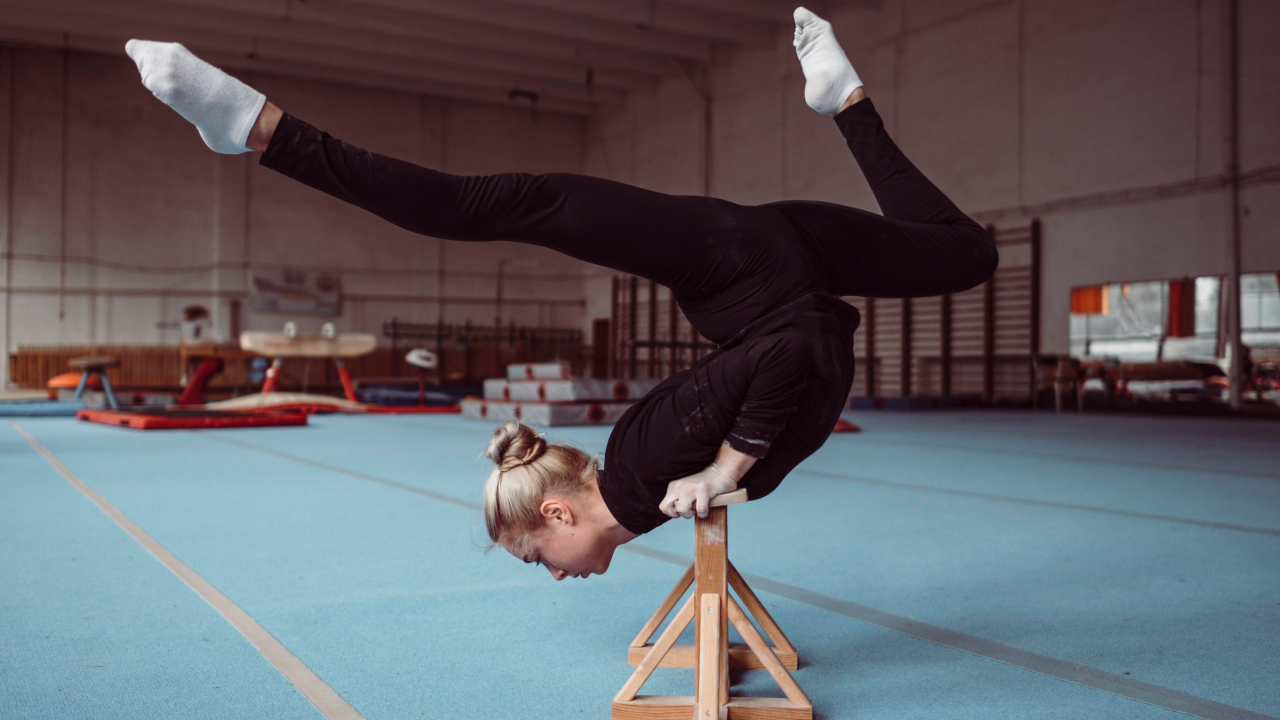
The concern did not appear out of nowhere. Elite athletes seen on television often have a compact build, and some research samples show later maturation. But a photograph of an Olympic gymnast cannot show what that person’s growth would have been without training.
The useful question from the original article remains: are gymnasts short because training made them short, or are shorter athletes more likely to enter and persist in elite gymnastics? It matters to parents considering classes, coaches managing training and young athletes worried about development.
What does “stunt growth” actually mean?
Before zooming in on gymnastics, let’s take a closer look at how growth works for children and adolescents. Height is influenced by inherited characteristics, nutrition and health. Pediatric Endocrine Society guidance distinguishes a child who is short but growing steadily from one whose growth trajectory is slowing.
Short stature describes height relative to age and sex. Growth velocity describes the rate of change. Skeletal maturation describes bone development; it is not the same as chronological age. Pubertal timing concerns the onset and progression of puberty. Final adult height is the attained outcome after growth is complete.
A child can be shorter than peers while still growing normally. A predicted adult height is an estimate, not a measured final result. Treating all these outcomes as “stunting” makes apparently conflicting findings harder to interpret.
What the research actually found

The chronology below includes findings that raise concerns as well as findings that favour selection effects. It does not pool unlike outcomes into one verdict. Study dates matter: historical athletes and training environments cannot automatically represent children attending classes today.
| Study/review | Population | What was measured | Main finding | Important limitation |
|---|---|---|---|---|
| 1993 · Theintz and colleagues | 22 female gymnasts and 21 swimmers, approximately age 12 at baseline; gymnastics training averaged 22 hours/week. | Prospective observations over a mean 2.35 years; body dimensions, puberty, growth velocity and predicted adult height. | Gymnasts showed slower growth and falling height predictions. Authors inferred a risk of reduced adult height. | Small historical cohort; predictions were not measured final stature. Training, diet and selection were not experimentally separated. |
| 2000 · Daly and colleagues | 31 competitive male gymnasts and 50 controls at baseline; prepubertal/early pubertal. | 18-month cohort; dimensions, hormones and diet. Growth comparisons included 18 gymnasts and 35 controls remaining in those maturity stages. | Gymnasts started shorter, but growth rates did not differ in the compared subgroup; authors favoured selection bias. | Limited developmental window and follow-up subgroup; does not establish every male athlete’s adult outcome. |
| 2001 · Caine and colleagues | Review of female gymnastics research; different ages and training exposures. | English-language literature review of growth, maturation and growth-plate evidence. | Some studies reported slower growth and subsequent catch-up; athletes could already be short before training. Causation was not established. | Confounding remained; evidence conflicted on whether catch-up was complete. No single pooled sample or universal risk estimate. |
| 2003 · Klentrou and Plyley | 45 elite female rhythmic gymnasts, mean ages about 14.5–14.7; 78 adolescent controls. | Comparative study: menstrual history, training profile, height, weight and body fat. | Later menarche and menstrual irregularity were observed among the gymnasts. | Associations, not proof of training causation; not an adult-height study. |
| 2013 · Malina and colleagues | Review of male and female artistic gymnasts; more evidence available for females. | FIG-convened expert literature review of adult/near-adult height, body segments, maturation and endocrine findings. | The review did not find compromised adult stature attributable to intensive artistic gymnastics training, allowing for its limitations. | Highly selected athletes, varied exposure measures and inadequate endocrine evidence. An expert review, not a randomized trial. |
| 2018 · Jürimäe and colleagues | 24 included articles on gymnastics and bone accrual during growth; populations varied. | Systematic review of bone mineral measures. | Artistic and rhythmic gymnasts generally had higher bone mineral measures than untrained controls. | Bone mineral findings do not answer whether an individual reaches expected adult height. |
| 2023 · IOC REDs consensus | Female and male athletes across sports; not one gymnastics cohort. | Expert consensus drawing on research about low energy availability and health/performance. | Problematic low energy availability can affect athlete health; sex and individual context matter. | Does not quantify a gymnastics-specific adult-height effect or diagnose an individual athlete. |
Why the studies reached different conclusions
The 1993 cohort raised a genuine concern about growth during intensive training, but its adult-height conclusion depended on predictions. The 2001 review reported both pre-existing shortness and slowed growth in some athletes, while noting uncertainty about catch-up. The 2013 review considered adult and near-adult outcomes and placed greater emphasis on selection and maturation differences.
These are not simply competing votes. They examine different populations, developmental stages and outcomes. WU’s interpretation is to preserve the early warning signals without treating height predictions as proof of permanently lost stature—or a reassuring review as a guarantee for every child.
The selection-bias problem
Inherited height, parental height, body proportions and maturation patterns are relevant before intensive training begins. Selection and dropout can further change the athletes who remain visible at elite level. The 2001 review found historical evidence that female gymnasts could already be short before beginning training.
Body size may affect the demands of particular skills, but “smaller is always better” is too broad. The male cohort is instructive: shorter starting dimensions persisted without a lower subsequent growth rate in the compared subgroup.
Comparing Olympic athletes with average children leaves out their starting characteristics and those who left the sport. It cannot, by itself, establish that gymnastics caused the difference.
Training versus energy availability
More training creates greater nutritional and recovery demands, but training hours alone do not diagnose under-fuelling. The 2023 IOC consensus distinguishes problematic low energy availability from exposures to which the body can adapt. Low energy availability means inadequate energy intake in relation to exercise expenditure.
Nutrition, recovery and body-composition pressure therefore belong in the investigation. Restrictive eating may be intentional; inadequate intake may also be unintentional. The original article’s claim that boys are largely protected by testosterone is not supported: REDs concerns include female and male athletes.
This framework cannot tell us which factor caused an individual growth change. Nor does it justify a universal training-hour limit, a calorie prescription or a promise that eating more will restore a particular adult height.
Artistic, rhythmic and recreational gymnastics are different exposures
Recreational gymnastics: Findings from intensive elite programmes should not be applied directly to children attending ordinary classes. The studies selected here do not establish a universal adult-height effect for recreational participants.
Competitive and elite artistic gymnastics: Training exposure varies within these labels. The adult-stature review addresses artistic gymnastics; its conclusion is not an assessment of every programme’s nutritional or injury risks.
Rhythmic gymnastics: The 2003 study documented later menarche and menstrual irregularity in elite adolescents. Those findings concern maturation and menstrual health, not demonstrated loss of adult height.
Male gymnasts: The male cohort supports selection as an explanation in its developmental window. It does not remove the need to assess nutrition, recovery or development in boys. Female-heavy research also limits generalisation.
Competition labels are not medical exposure measures. For the sporting progression itself, see how gymnastics levels work.
Growth plates: a different question
Growth occurs at growth plates in developing bones. Gymnastics can involve local overuse injury: AAOS describes repetitive wrist loading causing stress reactions at the distal radius growth plate. AAOS guidance on growth-plate fractures also explains that some injuries can disturb growth of the affected bone.
That is a clinically important risk, not proof that gymnastics systematically reduces whole-body adult height. Persistent wrist pain should not be dismissed because an article concludes that a general height claim is unproven. Our gymnastics injury guide covers the wider injury topic.
Bone health: benefits do not settle the height question
Gymnastics places substantial mechanical loads on bones. The 2018 systematic review found higher bone mineral measures among gymnasts than untrained controls. That preserves an important finding from the original article, but it is not proof of guaranteed protection against osteoporosis or growth problems.
Bone density, bone length and an injury to a growth plate are different outcomes. Nutritional and hormonal context still matters. A group-level mineral benefit cannot rule out injury or low energy availability in one athlete. Broader advantages belong in our benefits of gymnastics guide.
What the evidence cannot tell us
Much of this literature is observational, with small or historical samples and substantial attention to elite female athletes. Training exposure, nutrition, inherited height and biological maturation are not consistently measured or separated. Athletes leaving the sport can change follow-up samples.
The 2001 review could not establish training causation and found conflicting evidence about complete catch-up. The 2013 review also identified inadequate endocrine evidence. Neither gives us an individual child’s counterfactual height.
The selected evidence cannot provide a reliable universal rate of permanent height loss, prove that every delay is temporary, or guarantee an outcome after reducing training. An individual athlete’s story may prompt a question; it cannot establish a typical effect. No verified athlete case study or original expert interview is presented here.
Claims tested against the evidence
Claim: gymnastics automatically makes children shorter
Evidence: Selection effects and differing outcomes complicate the claim. Conclusion: An automatic permanent effect is not established. Uncertainty: That does not settle risks within a particular training environment.
Claim: starting young determines adult height
Evidence: The cited studies do not isolate starting age from later training, maturation and selection. Conclusion: Starting age alone is not a demonstrated explanation. Uncertainty: There is no individual height guarantee. See when children might start gymnastics for the separate participation question.
Claim: short Olympic gymnasts prove training stunts growth
Evidence: Elite competitors are a selected population, not a controlled experiment. Conclusion: Their appearance cannot establish causation. Uncertainty: Starting dimensions and training histories matter.
Claim: delayed puberty proves permanently restricted growth
Evidence: Pubertal timing and final stature are different measures. Conclusion: Delay alone is not proof of permanent height loss. Uncertainty: Its cause and significance need individual assessment.
Claim: growth-plate injuries prove gymnastics generally stunts height
Evidence: Local injury can affect the injured bone. Conclusion: A local risk does not demonstrate a systematic whole-body effect. Uncertainty: The prognosis of an injury depends on its site, severity and clinical findings.
What parents should actually watch
Look at the child’s development over time rather than comparing their appearance with teammates. Growth-chart guidance identifies slowing growth and crossing down percentile lines as reasons for assessment; short stature alone can also reflect normal family patterns.
Discuss concerns with a paediatrician or an appropriate sports-medicine professional if there are unexpected growth changes, delayed pubertal development, inadequate intake, persistent fatigue, restrictive eating, recurrent injuries, menstrual disruption or a training/recovery imbalance. These signs do not diagnose REDs or prove gymnastics is responsible.
Bring growth records, the training schedule, recent injuries and concerns about eating or recovery. A clinician can decide whether further nutritional, endocrine or injury assessment is appropriate. Routine hormone tests and bone scans are not automatically required for every gymnast.
Supporting development without promising extra height
The useful priorities from the original article remain: adequate nutrition, age-appropriate training, recovery, sleep and an environment where an athlete can report pain or difficulty eating without shame. Avoid judging health by leanness or treating a menstrual change as a badge of commitment.
Ask who monitors training load, how pain is handled and how nutritional concerns are referred. Individualised help from a qualified sports dietitian may be appropriate. This is decision support, not a prescribed diet, testing schedule or treatment plan.
Investigation verdict
The evidence does not support the simple claim that participating in gymnastics inherently makes children permanently shorter. Some historical research reported slower growth during intensive training; broader review conclusions have not established reduced final adult stature as an effect of training itself. Selection, maturation and training environment make attribution difficult.
The practical distinction is therefore not merely gymnastics versus no gymnastics. Consider the individual athlete, training exposure, nutrition, recovery and development. An unproven general height claim should neither frighten every family away from classes nor dismiss a child’s growth or injury concerns.
Sources, expert context and investigation method
Evidence review date: 30 September 2026. This is a focused editorial investigation, not a new systematic review or clinical assessment. We compared peer-reviewed study records and reviews with IOC, paediatric endocrine and orthopaedic guidance. The chronology identifies populations, measured outcomes, findings and limitations.
Expert context comes from published research and institutional guidance. Statements here are WU paraphrases, not manufactured quotations or interviews. Several older studies were checked through their indexed abstracts; full methods were not available for every paper. The 2023 consensus has a linked 2024 correction. No numerical threshold or treatment protocol is reproduced from it.
The table provides specific research links. For practical context, consult Pediatric Endocrine Society: short stature, delayed puberty in girls, delayed puberty in boys, and AAOS: childhood overuse injuries.
The retained images are illustrative; they are not records of participants in these studies and cannot demonstrate growth, diagnosis or causation. No original athlete journey is asserted, and no Evidence Engine candidate is treated as approved evidence.